Loading...
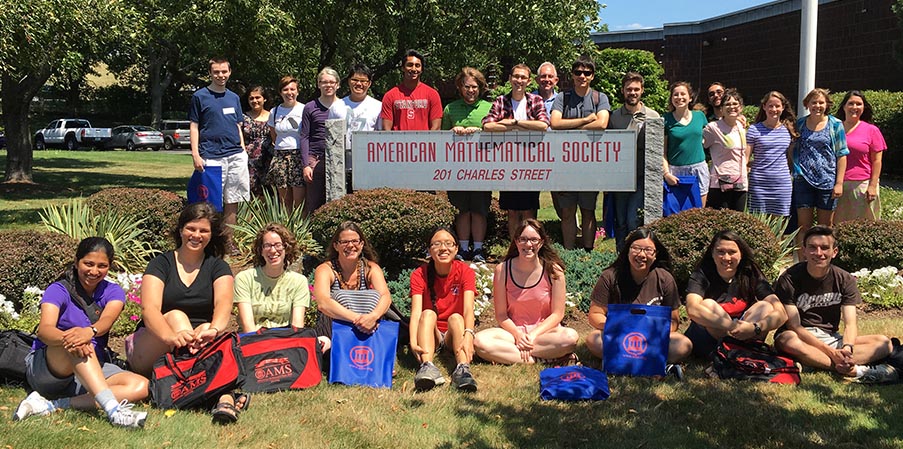
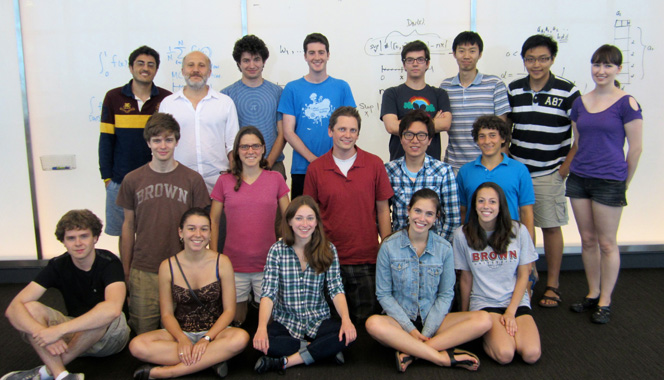
The Summer@ICERM program at Brown University is an eight-week residential program designed for a select group of 18-22 undergraduate scholars.
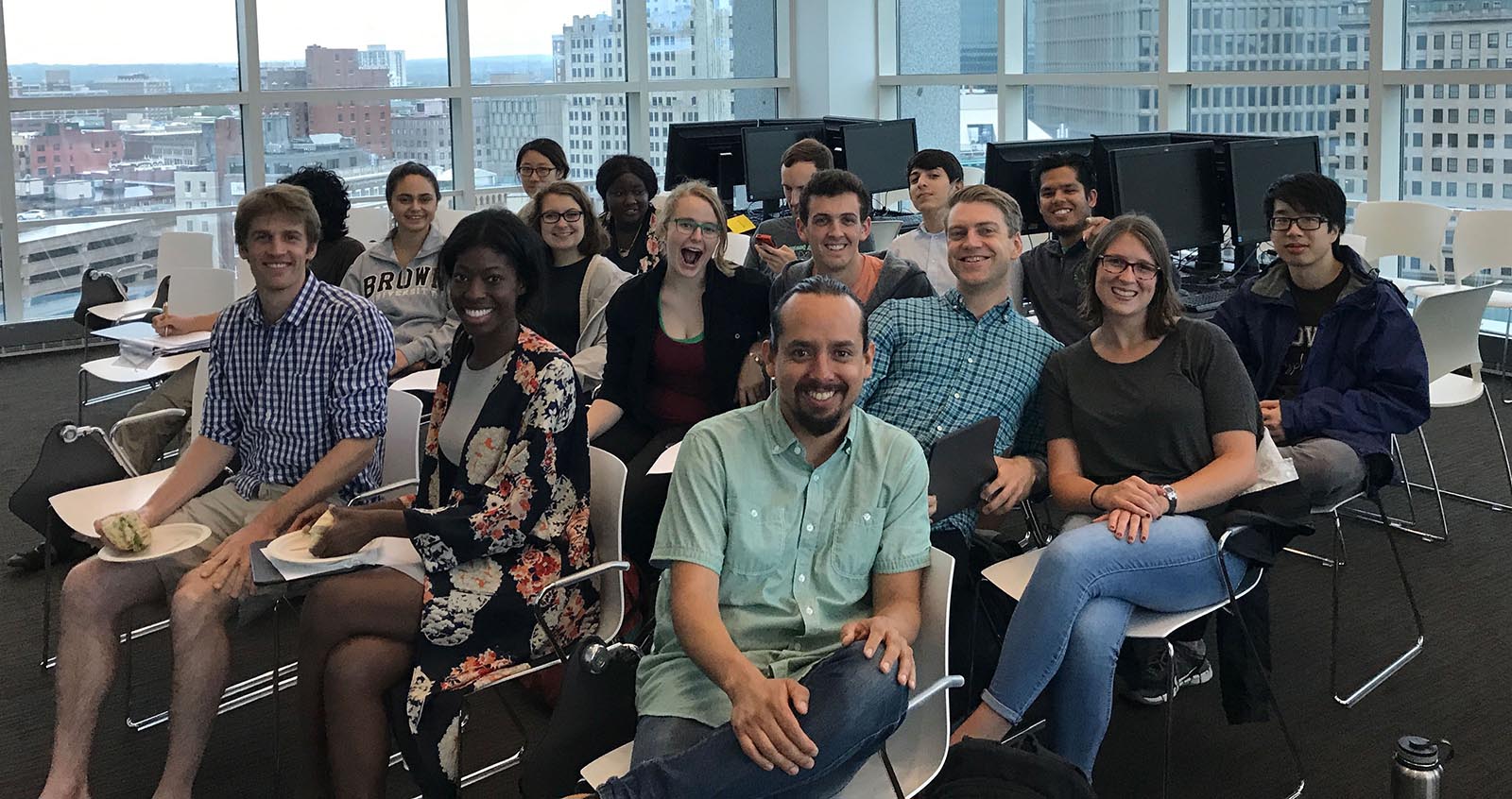
Every year, faculty organizers develop a variety of topical research projects that are interdisciplinary in nature. They begin the program with brief introductory talks about each project. Throughout the eight-week program, students work on their assigned projects in groups of two-to-four, mentored by faculty advisors and teaching assistants. Students meet daily, give regular talks about their findings, attend mini-courses and guest talks, and participate in professional development seminars.
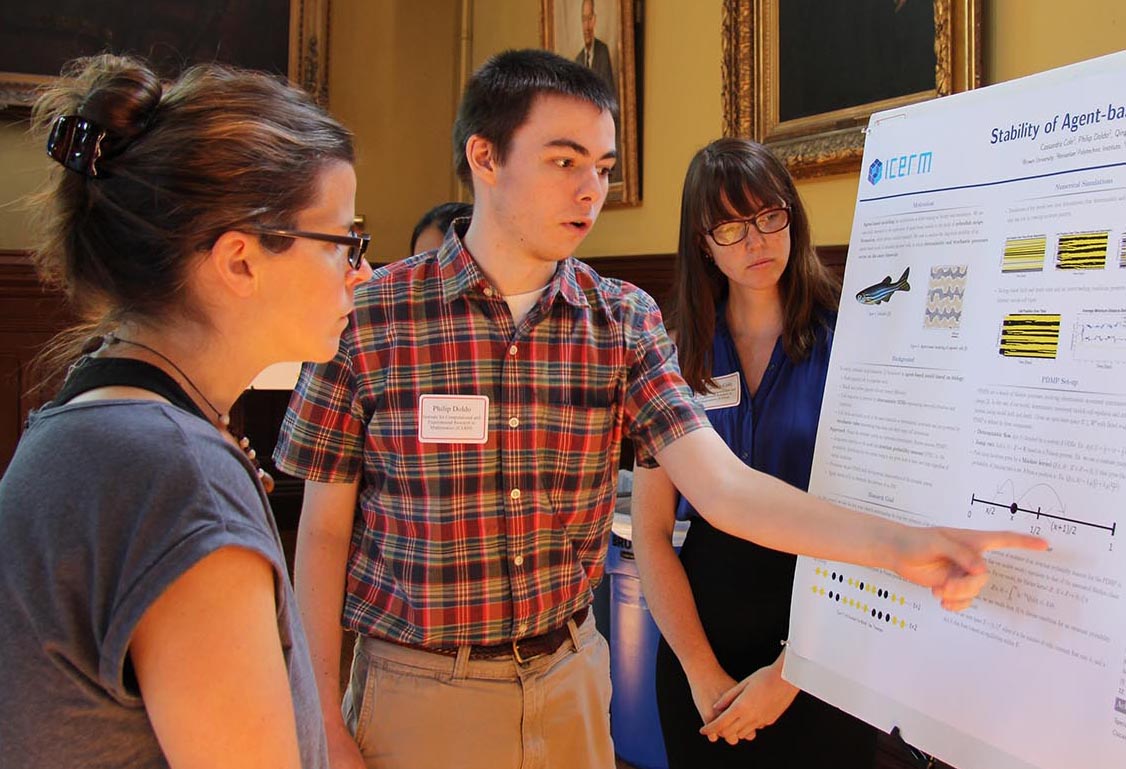
Students learn how to collaborate mathematically while attending Summer@ICERM, and they work closely with their teammates to write up their research into a poster and/or paper by the end of the program.
ICERM provides an excellent research environment; students and their faculty and TA mentors have access to shared offices and collaborative space throughout the institute. They also have access to ICERM's computer facilities and specialized software. ICERM staff provide logistical support for students and help build community through fun activities and events.
Program Details
- Funding Includes
- $4,800 stipend
- Dormitory housing
- Meal plan
- Travel support within U.S.
- Deadline
- Mid-February
Applicants must be matriculating undergraduate students at the time of the Summer@ICERM program.
Funding is available for a very small number of students who are not US citizens or permanent residents.
Upcoming Summer@ICERM programs are posted in the fall of each year.
Summer@ICERM 2026: Pure and Applied Mathematical Models
Jun 8 - Jul 31, 2026
Organizing Committee
Lewis University
Lewis University
Lewis University
Villanova University
Visit the Summer@ICERM 2026: Pure and Applied Mathematical Models event page for full details on the program.
Summer@ICERM Past Programs


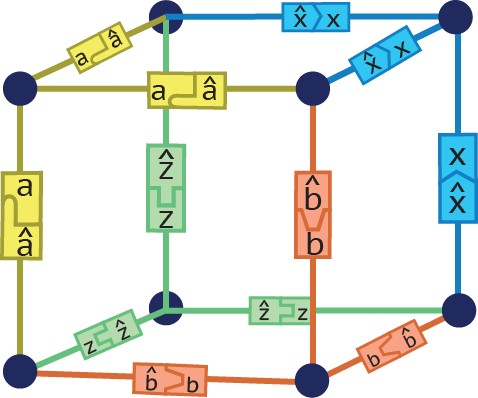
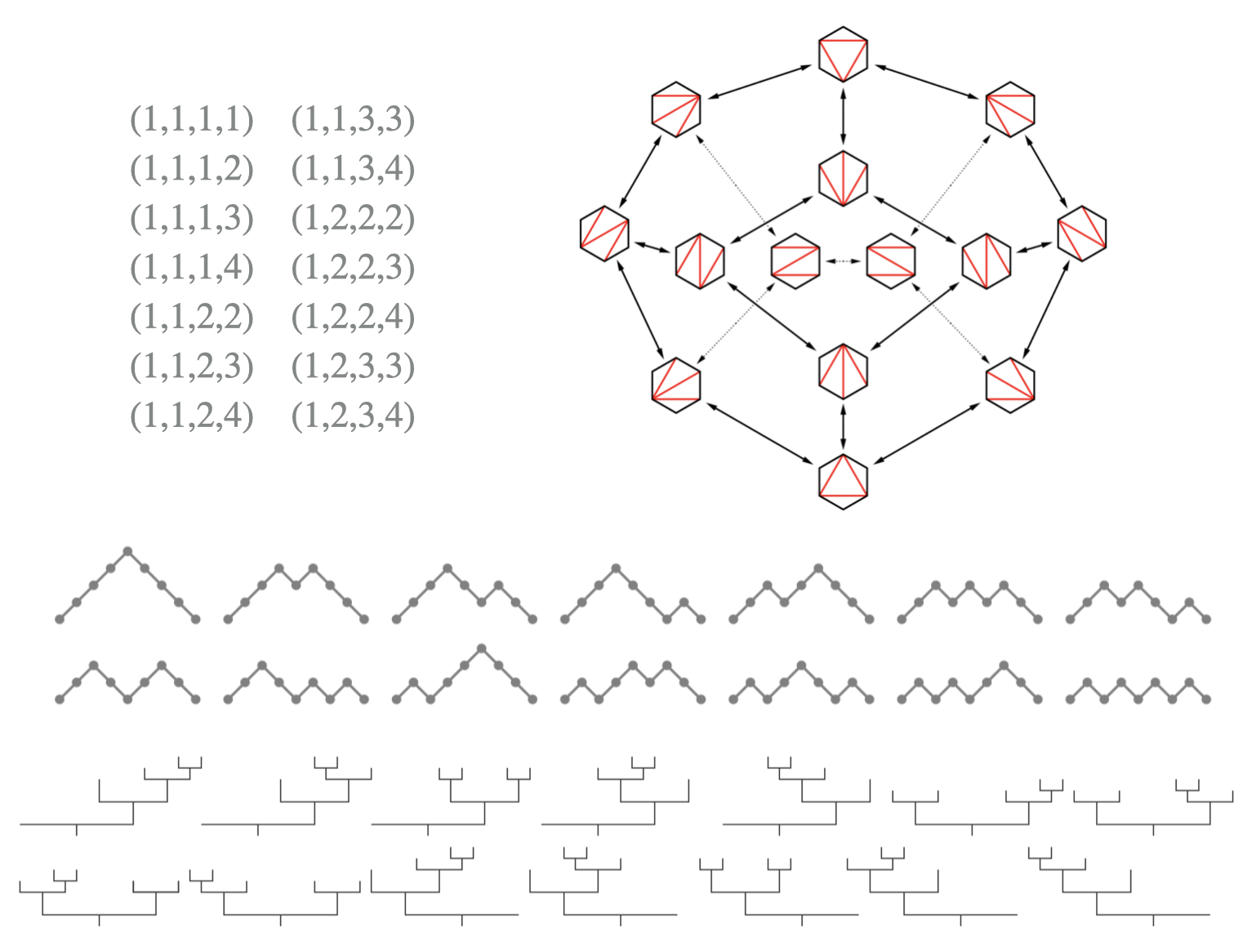
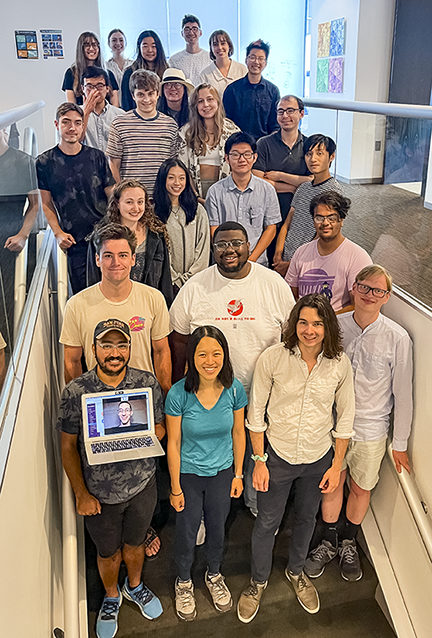
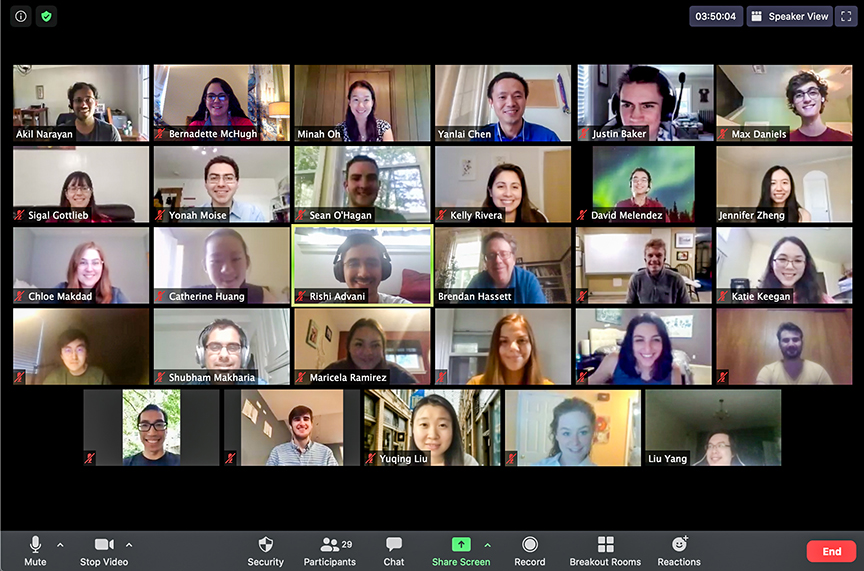
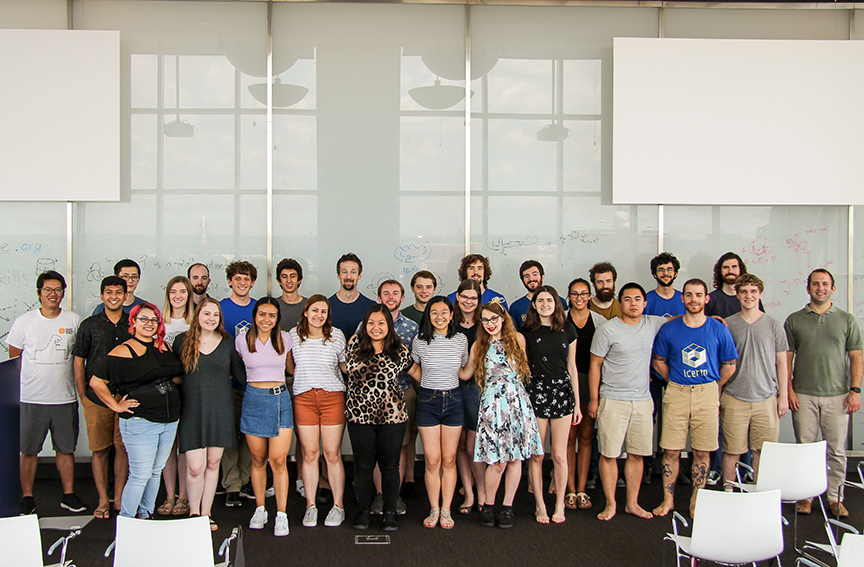
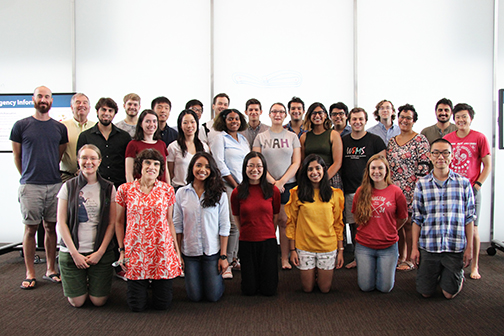
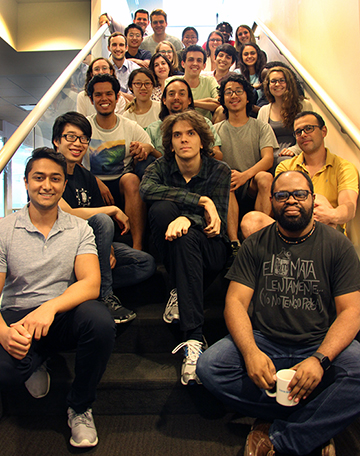
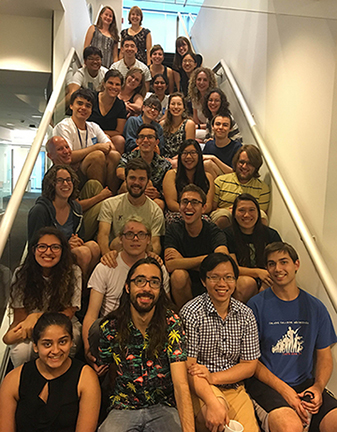
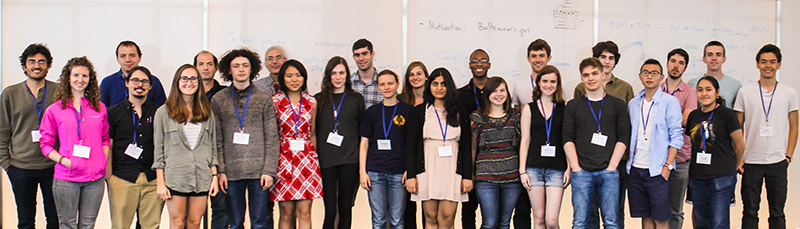
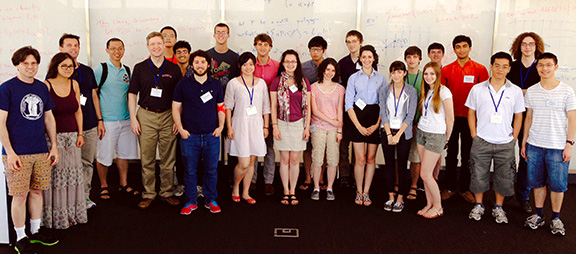
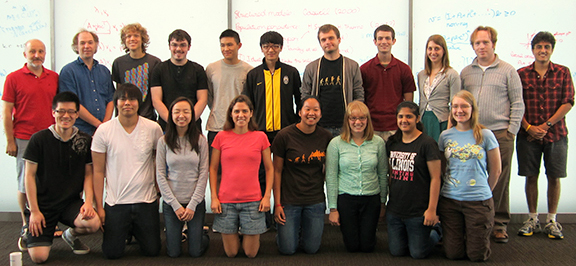
Publications
- Zoë Bell, Jasmine Camero, Karina Cho, Trevor Hyde, Chieh-Mi Lu, Bianca Thompson, Eric Zhu, Density of periodic points for Latt\`es maps over finite field, J. Number Theory 238 (2022), 951-966.
- Joshua Brown, Yutong Bu, Zachary Cheesman, Benjamin Orman, Iris Horng, Samuel Thomas, Amanda Harsy, Adam Schultze, Predictive Modeling of Lower-Level English Club Soccer Using Crowd-Sourced Player Valuations, Mathematics and Sports 7 (2025) no. 1.
- Priscilla Doran, Natsuka Hayashida, Kristen Joyner, Grace Moberg, Austin Kind, Matthew Senese, Brittany Stephenson, Cara Jill Sulyok, A mathematical model of <i>Clostridioides difficile</i> transmission in long-term care facilities, Mathematical Biosciences and Engineering 22 (2025) no. 12, 3201-3235.
- Mia Adler, Ford McDill, Tiffanie Ng, Will Paz, Iris Horng, Samuel Thomas, Amanda Harsy, Adam Schultze, Money Bull: Analyzing the Application of Ranking Methods to Rodeo, Maths and Sports 7 (2025).
- Grace Bielefeldt, Iris Horng, Holly Luebsen, Mitchell VonEschen, Leyda Almodovar Velazquez, Amanda Harsy Ramsay, Cory Johnson, Jessica Sorrells, Algorithmic Generation of DNA Self-Assembly Graphs, vol. 8, 2025, pp. 141–172.
- Julia Cai, Benjamin Hutz, Leo Mayer, Max Weinreich, Automorphism Groups of Endomorphisms of $\mathbbP^1 (\bar\mathbbF_p)$, arXiv:2003.12113, 2022.
- Melissa R. McGuirl and Katherine M. Kinnaird and Claire Savard and Erin H. Bugbee, SE and SNL diagrams: Flexible data structures for MIR, Proceedings of the 19th International Society for Music Information Retrieval Conference, 2018, pp. 341-347.
- Boyan Xu, Christopher J. Tralie, Alice Antia, Michael Lin, Jose A. Perea, Twisty Takens: A geometric characterization of good observations on dense trajectories, Journal of Applied and Computational Topology 3 (2019) no. 4, 285-313.
- Brandon Gontmacher, Benjamin Hutz, Grayson Jorgenson, Srinjoy Srimani, Simon Xu, Automorphism loci for degree 3 and degree 4 endomorphisms of the projective line, arXiv:2007.15483, 2021.
- Heidi Benham, Alexander Galarraga, Benjamin Hutz, Joey Lupo, Wayne Peng, Adam Towsley, New Normal Forms For Degree Three Polynomials and Rational Functions, arXiv:2001.06164, 2022.
- Anna Chlopecki, Juliano Levier-Gomes, Wayne Peng, Alex Shearer, Adam Towsley, Permutation polynomials: iteration of shift and inversion maps over finite fields, arXiv:1910.12928, 2021.
- Talia Blum, John R. Doyle, Trevor Hyde, Colby Kelln, Henry Talbott, Max Weinreich, Dynamical moduli spaces and polynomial endomorphisms of configurations, arXiv:2108.10777, 2021.
- Charles Daly, Jonah Gaster, Max Lahn, Aisha Mechery, Simran Nayak, Algebraic k-systems of curves, daly2020algebraic:1911.08469, 2020.
- Jonah Gaster, Miguel Lopez, Emily Rexer, Zoë Riell, Yang Xiao, Combinatorics of \textdollark\textdollar-Farey graphs, Rocky Mountain Journal of Mathematics 50 (2020) no. 1.
- Shuchi Agrawal, Tarik Aougab, Yassin Chandran, Marissa Loving, J. Robert Oakley, Roberta Shapiro, Yang Xiao, Automorphisms of the k-curve graph, agrawal2023automorphisms:1912.07666, 2023.
- Henry Adams, Samir Chowdhury, Adam Quinn Jaffe, Bonginkosi Sibanda, Vietoris-Rips Complexes of Regular Polygons, adams2018vietorisrips:1807.10971, 2018.
- Samir Chowdhury, Nathaniel Clause, Facundo Memoli, Jose Angel Sanchez, Zoe Wellner, New families of simplicial filtration functors, chowdhury2017new:1712.00696, 2017.
- Jennifer Elder, Pamela E. Harris, Zoe Markman, Izah Tahir, Amanda Verga, On Flattened Parking Functions, elder2023flattened:2210.14206, 2023.
- Douglas Chen, Pamela Harris, J. Carlos Martinez Mori, Eric J. Pabon-Cancel, Gabriel Sargent, Permutation invariant parking assortments, Enumerative Combinatorics and Applications 4 (2023) no. 1, Article #S2R4.
- Lucas Chaves Meyles, Pamela E. Harris, Richter Jordaan, Gordon Rojas Kirby, Sam Sehayek, Ethan Spingarn, Unit-Interval Parking Functions and the Permutohedron, meyles2023unitinterval:2305.15554, 2023.
- Cara Bennett, Lucy Martinez, Ava Mock, Gordon Rojas Kirby, Robin Truax, Repetitions of Pak-Stanley Labels in $G$-Shi Arrangements, bennett2022repetitions:2210.13613, 2022.
- Rishi Advani, Sean O'Hagan, Efficient Algorithms for Constructing an Interpolative Decomposition, advani2022efficient:2105.07076, 2022.
- Heidi Benham, Alexander Galarraga, Benjamin Hutz, Joey Lupo, Wayne Peng, Adam Towsley, Integrality and Thurston Rigidity for Bicritical PCF Polynomials, arXiv:2212.02558, 2022.
- Zawad Chowdhury, Samuel Everett, Samuel Freedman, Destine Lee, Computing Periodic Points on Veech Surfaces, 2021.
- Samuel Everett, Vanessa Lin, Aidan Mager, Long and Short Periodic Billiard Trajectories in the Regular Pentagon, 2021.
- Jennifer Zheng, Media Processing and A Modified Watermarking Scheme Based on the Singular Value Decomposition, SIAM Undergraduate Research Online 14 (2021).
- Mei Rose Connor, Diana Davis, Paige Helms, Samuel Lelièvre, Michael Kielstra, Zachary L. Steinberg, Chenyang Sun, Hyperbolic Staircases: Periodic Paths on 2g+1-gons, 2021.
- Rishi Advani, Madison Crim, Se C. O’Hagan, Random Projections and Dimension Reduction, ArXiv abs/2008.04552 (2020).