
Organizing Committee
- Andrew Christlieb
Michigan State University - Cecilia Clementi
Rice University - Keith Promislow
Michigan State University - Mark Tuckerman
New York University - Zhengfu Xu
Michigan Technological University
Abstract
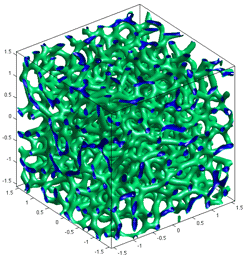
Many important advances in material and biomedical science will come from controlling the chemical properties and nanoscale morphology of polymer mixtures. Predicting the longtime continuum-level properties of such complex systems poses a canonical computational challenge due to the disparate length and time scales separating the molecular description from the macroscopic behavior, particularly the evolution of morphology. This workshop focuses on four overlapping approaches to bridging this gap: Accelerated Molecular Methods, Coarse-Graining of Molecular Dynamics, Computational Approaches to Self-Consistent Mean Field, and Coupled Molecular and Continuum-Variational models. The goal is to spur the development of hybrid computational methods with the capacity to identify and characterize the rare events and the driving forces which steer the systems towards equilibrium, and connect the burgeoning growth in parallel-computation techniques for particle-based systems with recently developed classes of continuum models.
Confirmed Speakers & Participants
Talks will be presented virtually or in-person as indicated in the schedule below.
- Speaker
- Poster Presenter
- Attendee
- Virtual Attendee
-
Giovanni Bussi
International School for Advanced Studies (SISSA/ISAS)
-
Maria-Carme Calderer
University of Minnesota
-
Andrew Christlieb
Michigan State University
-
Cecilia Clementi
Rice University
-
Kris Delaney
University of California, Santa Barbara
-
Jaylan Jones
Michigan State University
-
Yannis Kevrekidis
Princeton University
-
Sharon Loverde
University of Pennsylvania
-
Jianfeng Lu
Duke University
-
Mauro Maggioni
Johns Hopkins University
-
Nicolas Moreno Chaparro
King Abdullah University of Science & Technology
-
Marcus Müller
Georg-August-Universität zu Göttingen
-
Stephen Paddison
University of Tennessee
-
Kellen Petersen
Courant Institute of Mathematical Sciences
-
Raffaello Potestio
Max Planck Institute for Polymer Research
-
Keith Promislow
Michigan State University
-
Jutta Rogal
Ruhr-Universität Bochum
-
An-Chang Shi
McMaster University
-
Wataru Shinoda
National Institute of Advanced Industrial Science and Technology
-
Mark Tuckerman
New York University
-
Eric Vanden-Eijnden
New York University
-
Qiang Wang
Colorado State University
-
Zhengfu Xu
Michigan Technological University