Loading...
Organizing Committee
University of Texas, Austin
Massachusetts Institute of Technology
University of California, Merced
Abstract
Interested in discussing cutting edge research ideas with both peers and leaders in their field?
Interested in broadening your professional network across the mathematical sciences?
Interested in the opportunity to present your ideas and hear about funding opportunities from program officers?
Idea-Lab is a one-week program aimed at 15 early career researchers (within five years of their Ph.D.) that will focus on a topic at the frontier of research. Participants will be exposed to a problem whose solution may require broad perspectives and multiple areas of expertise. Senior researchers will introduce the topic in tutorials and lead discussions. The participants will break into teams to brainstorm ideas, comprehend the obstacles, and explore possible avenues towards a solution. The teams will be encouraged to develop a research program proposal. On the last day, they will present their ideas to one another and to a small panel of representatives from funding agencies for feedback and advice.
IdeaLab applicants should be at an early stage of their post-Ph.D. career. A CV, research statement, and two reference letters are required.
Interested in broadening your professional network across the mathematical sciences?
Interested in the opportunity to present your ideas and hear about funding opportunities from program officers?
Idea-Lab is a one-week program aimed at 15 early career researchers (within five years of their Ph.D.) that will focus on a topic at the frontier of research. Participants will be exposed to a problem whose solution may require broad perspectives and multiple areas of expertise. Senior researchers will introduce the topic in tutorials and lead discussions. The participants will break into teams to brainstorm ideas, comprehend the obstacles, and explore possible avenues towards a solution. The teams will be encouraged to develop a research program proposal. On the last day, they will present their ideas to one another and to a small panel of representatives from funding agencies for feedback and advice.
IdeaLab applicants should be at an early stage of their post-Ph.D. career. A CV, research statement, and two reference letters are required.
Loading...
Loading participant list in background...
IdeaLab Topic
Inverse Problems and Uncertainty Quantification
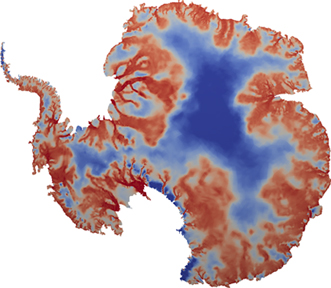
Inverse problems arise in an enormous variety of science and engineering applications. Examples range from understanding the dynamics of Antarctic ice sheets to developing predictive models of combustion emissions. In all these applications, model parameters must be estimated from noisy and indirect observational data. Uncertainty is integral to this endeavor: observational errors, model errors, and issues of ill-posedness yield uncertainties in model parameters. More broadly, the solution of inverse problems can be viewed as the interpretation of data through the lens of models that capture key relationships between measured quantities, the state and parameters of a system, and the ultimate quantities of interest to the modeler.
Bayesian statistical approaches to inverse problems offer the ability to endow model parameters and subsequent predictions with quantified uncertainties, reflecting both prior information and the information available in observations. Quantifying uncertainty in predictions of interest in turn enables coherent approaches to model-based decision making. While the past several years have seen significant advances in both the theoretical formulation of Bayesian inverse problems and the development of effective computational tools for their solution, many important and long-standing challenges remain: methods for efficient posterior exploration in high or infinite-dimensional parameter spaces, algorithms that exploit the structure of expensive PDE-based forward models, algorithms for parsing and reducing "big data" in the context of inversion, the construction of controlled approximations to the posterior distribution and its constituent models, the development of physically meaningful yet mathematically coherent prior distributions, and methods for incorporating model errors into the inverse solution and subsequent predictions.
The goal of this IdeaLab is to lay out the fundamentals of uncertainty quantification for inverse problems in a relatively rapid but hands-on manner, so that participants can understand and fluently discuss the current state of the art. We will also present connections to classical (regularization-based) inverse problems. We will then brainstorm projects focusing on new methodological approaches and new applications. The session will benefit from collaboration among participants with diverse mathematical and computational interests, ranging from statistics and machine learning to optimization and numerical PDE, as well as interests across a broad set of science and engineering application areas.
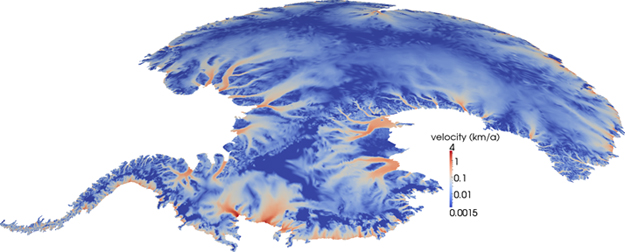
Satellite observations of surface ice flow velocity used to solve Antarctic ice sheet inverse problem, along with a model of ice flow as a non-Newtonian fluid