Loading...
Organizing Committee
Dartmouth College
Rice University
University of California San Diego
Université de Poitiers
Rice University
Abstract
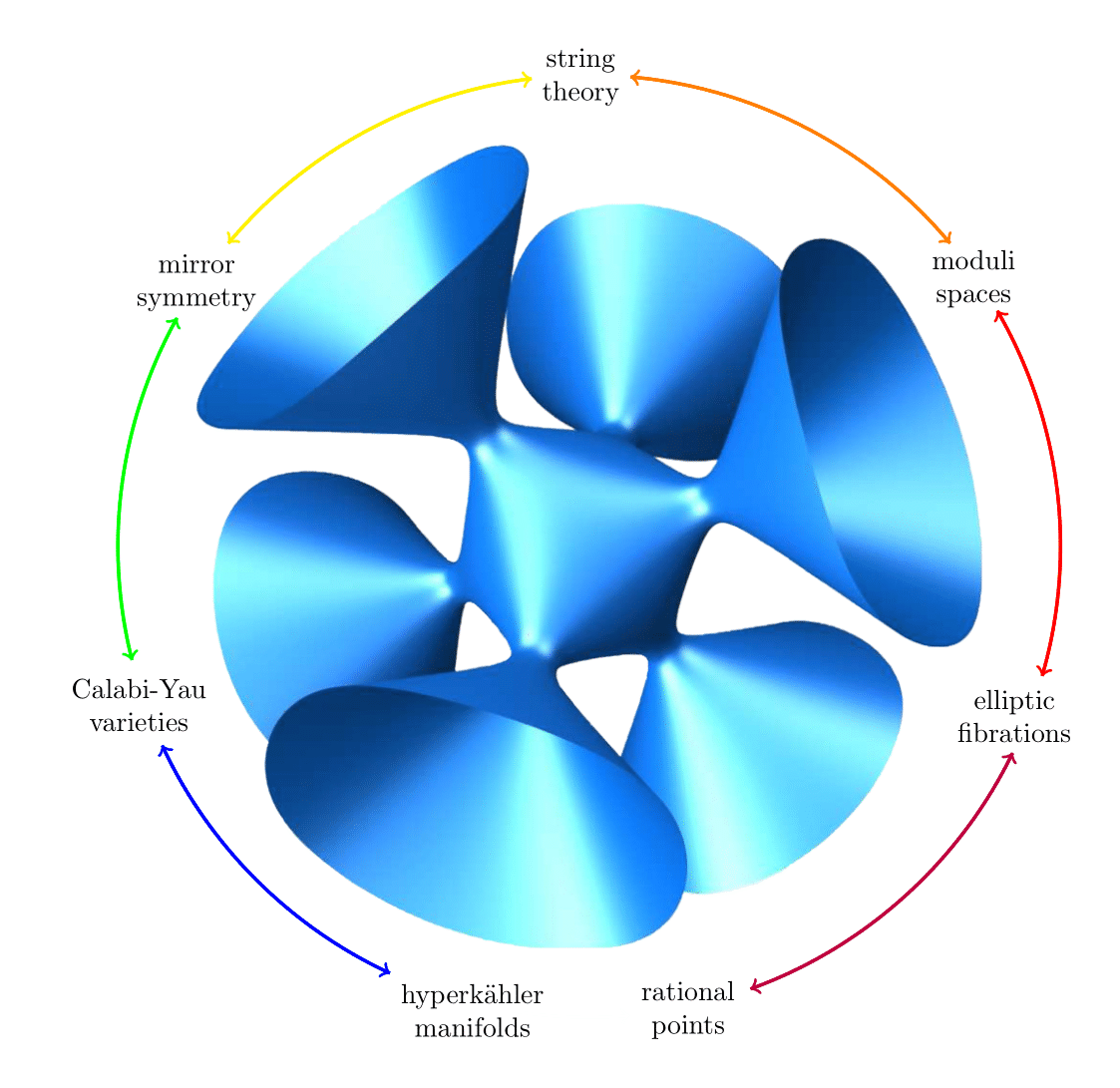
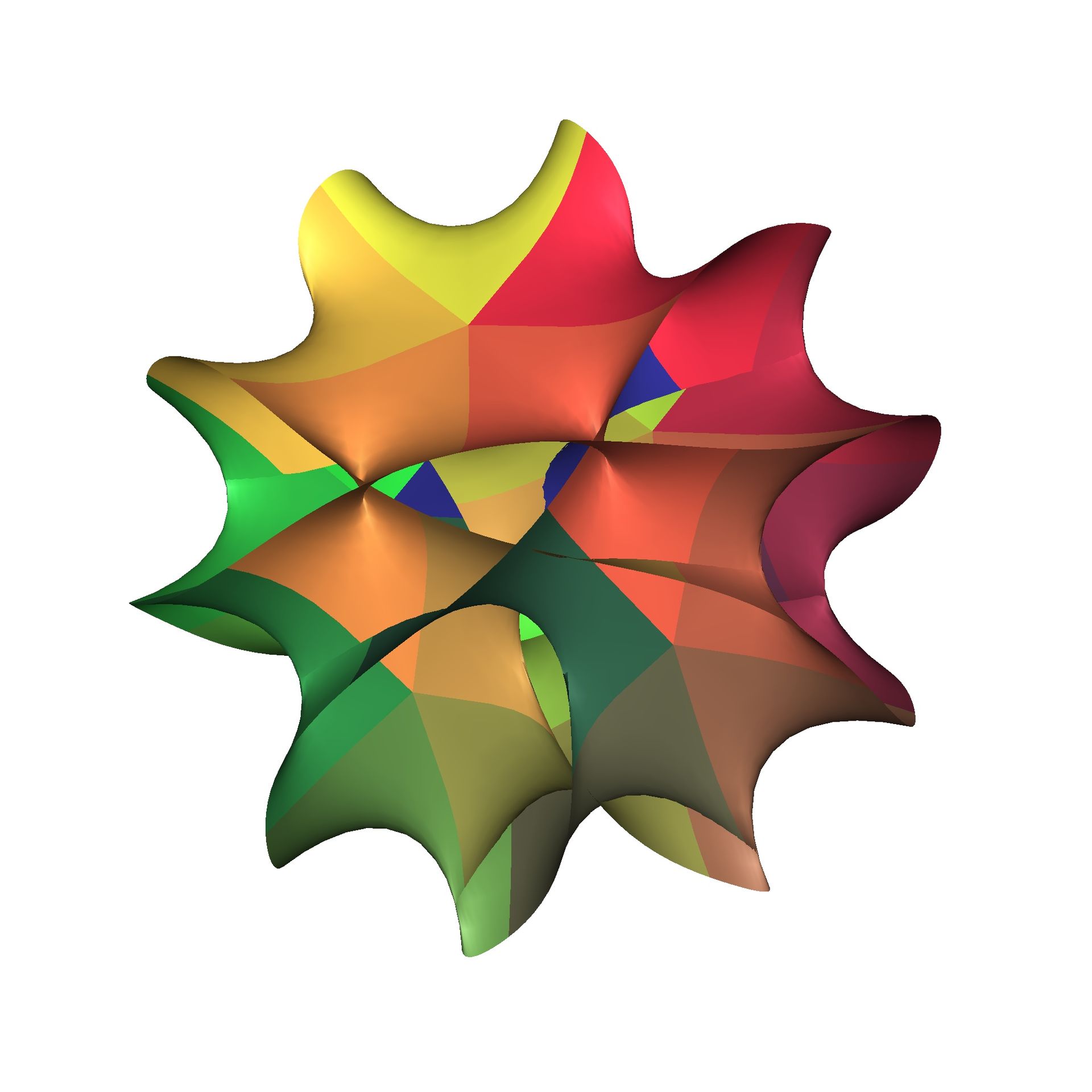
Cubic fourfolds and Gushel-Mukai fourfolds are bound to K3 surfaces through geometry and Hodge theory; when they contain unexpected surfaces, their middle cohomology contains a Hodge structure matching that of a K3 surface. This association contains rich geometry and involves certain Hyperkähler manifolds associated to the cubic fourfold. Hyperkähler manifolds are higher-dimensional generalizations of K3 surfaces, whose second cohomology group with integer coefficients has a lattice structure that allows us to study them with tools analogous to those used to understand K3 surfaces. The past 30 years have seen significant advances and new avenues develop in the study of the geometry of cubic fourfolds, Gushel-Mukai fourfolds, and high-dimensional Hyperkähler manifolds.
The aim of this workshop is to bring together experts from algebraic and arithmetic geometry to exchange mutually beneficial points of view. For example, are there computations over finite fields that could inform or lead to a Honda-Tate theory for K3 surfaces? Are there exotic automorphism groups of high-dimensional Hyperkähler manifolds in positive characteristic? What geometric insights can be descended to number fields for applications to the study of rational points and the Brauer-Manin obstruction? We hope to study these and many other similar questions.
The aim of this workshop is to bring together experts from algebraic and arithmetic geometry to exchange mutually beneficial points of view. For example, are there computations over finite fields that could inform or lead to a Honda-Tate theory for K3 surfaces? Are there exotic automorphism groups of high-dimensional Hyperkähler manifolds in positive characteristic? What geometric insights can be descended to number fields for applications to the study of rational points and the Brauer-Manin obstruction? We hope to study these and many other similar questions.
Loading...
Loading participant list in background...
Workshop Schedule
Monday, October 26, 2026
8:30 - 8:50 AM
Check In
11th Floor Collaborative Space
8:50 - 9:00 AM
Welcome
11th Floor Lecture Hall
Brendan Hassett, ICERM/Brown University
9:00 - 9:45 AM
Isotrivial Lagrangian fibrations and beyond
11th Floor Lecture Hall
Speaker
Radu Laza, Stony Brook University
Session Chair
Kiran Kedlaya, University of California San Diego
Abstract
I will discuss my work with YJ Kim and O. Martin on the classification of isotrivial Lagrangian fibrations for hyperKahler manifolds. I will then preview a number of related topics such as the classification of hyper-Kummer varieties (ongoing work with Engel and Marquand).
10:00 - 10:30 AM
Coffee Break
11th Floor Collaborative Space
10:30 - 11:15 AM
Existence and uniqueness of Lagrangian fibrations by Prym varieties
11th Floor Lecture Hall
Speaker
Justin Sawon, University of North Carolina - Chapel Hill
Session Chair
Kiran Kedlaya, University of California San Diego
Abstract
A Lagrangian fibration is a fibration of a symplectic variety whose general fibre is an abelian variety that is Lagrangian wrt the symplectic structure. Examples whose fibres are Prym varieties coming from (possibly branched) double covers of curves were constructed by Markushevich-Tikhomirov and others. In this talk we consider the question of existence and uniqueness of examples in various dimensions and for curves of various genera.
11:30 AM - 12:15 PM
Non-special divisors in the moduli space of cubic fourfolds
11th Floor Lecture Hall
Speaker
Elena Sammarco, ICERM, Brown University
Session Chair
Kiran Kedlaya, University of California San Diego
Abstract
The moduli space of smooth cubic fourfolds contains a countable union of special divisors, defined by the presence of additional algebraic classes. In contrast, non-special divisors, whose general points lie outside the Noether–Lefschetz locus, are much less studied. In this talk, we will first survey the known examples of non-special divisors and then focus on a geometric construction based on polar quadrics and Severi varieties of plane curves. In particular, we will consider cubic fourfolds admitting a net of polar quadrics whose discriminant is a plane sextic with at least ten nodes. This construction yields five irreducible non-special divisors, whose union we call the Severi divisor. We will outline the geometric ideas underlying the proof that these divisors are not of Noether–Lefschetz type.
12:30 - 2:30 PM
Lunch/Free Time
2:30 - 3:15 PM
The Abel-Jacobi map for Gushel-Mukai 5folds
11th Floor Lecture Hall
Speaker
Giulia Saccà, Columbia University
Session Chair
Kiran Kedlaya, University of California San Diego
Abstract
Given a smooth projective variety X, the Abel-Jacobi map relates families of cycles on X of a given codimension to the intermediate Jacobian of X of the corresponding degree, generalizing the case of families of points on a smooth projective curve. In this talk, I will discuss some properties of the Abel-Jacobi map for surfaces on Gushel-Mukai 5folds, extending some results of Debarre and Kuznetsov. This is joint work with E. Macrì and K. O'Grady.
3:30 - 4:00 PM
Coffee Break
11th Floor Collaborative Space
4:00 - 4:45 PM
Degenerations of generalized Kummer varieties
11th Floor Lecture Hall
Speaker
Klaus Hulek, Leibniz-University Hannover
Session Chair
Kiran Kedlaya, University of California San Diego
Abstract
The aim of this talk is to explain an explicit constructions of degenerations of generalized Kummer varieties. This is based on the degeneration techniques for generalized Hilbert schemes of K3 surfaces which was developed by the speaker together with M. Gulbrandsen, L. Halle and, later, also Z. Zhang. We shall discuss the geometry of the degenerations. This is joint work with with L. Halle and Z. Zhang.
5:00 - 6:30 PM
Reception
11th Floor Collaborative Space
Tuesday, October 27, 2026
9:00 - 9:45 AM
Birational automorphisms of hyperkähler manifolds in families
11th Floor Lecture Hall
Speaker
Ekaterina Amerik, Universite de Paris XI (Paris-Sud)
Session Chair
Sarah Frei, Rice University
Abstract
This is a joint work with Andrey Soldatenkov and Misha Verbitsky. In the beginning of the 90's Oguiso proved that in any nontrivial family of projective K3 surfaces X_t over a disc, there is a dense subset of t's such that Aut(X_t) is infinite. I shall explain how this generalizes to hyperkähler manifolds.
10:00 - 10:30 AM
Coffee Break
11th Floor Collaborative Space
10:30 - 11:15 AM
A family of birational models of generalized Kummer varieties as coverings of a projective 4-space
11th Floor Lecture Hall
Speaker
Samuel Boissière, Université de Poitiers
Session Chair
Sarah Frei, Rice University
Abstract
I will describe birational models of generalized Kummer fourfolds as degree 15 ramified coverings of the projective 4-space. The starting point of this work in collaboration with Gregory Sankaran and Marc Nieper-Wisskirchen is a geometric interpretation of the group law on the Jacobian of a genus 2 curve based on the linear system of cubics on the curve.
11:30 AM - 12:15 PM
Birational cubic fourfolds via Enriques Cremona transformations
11th Floor Lecture Hall
Speaker
Lisa Marquand, Rutgers University
Session Chair
Sarah Frei, Rice University
Abstract
The birational geometry of a cubic fourfold is notoriously difficult to study. In particular, birational maps between (conjecturely) irrational cubic fourfolds are few and far between. We focus on the codimension 1 loci of cubic fourfolds containing an Enriques surface. We produce a Cremona transform of P^5, based in a Fano embedded Enriques surface as well as twenty planes. Using this, we produce birational maps between cubic fourfolds containing this surface and their unique Fourier Mukai partners. This is joint work with Corey Brooke.
12:30 - 2:30 PM
Lunch/Free Time
2:30 - 2:37 PM
Autoduality of compactified Prym varieties
Lightning Talks - 11th Floor Lecture Hall
Speaker
Huishi Yu, Peking University
Session Chair
Sarah Frei, Rice University
Abstract
In this talk, I will discuss the Fourier--Mukai transform induced by a Poincaré sheaf on compactified Prym varieties associated with étale double covers of integral curves with planar singularities. As an application, I will explain how this Fourier theory applies to the Laza--Saccà--Voisin fibration, an OG10-type Lagrangian fibration.
2:37 - 2:44 PM
The Beilinson-Bloch conjecture for some non-isotrivial varieties over global function fields
Lightning Talks - 11th Floor Lecture Hall
Speaker
Matt Broe, Boston University
Session Chair
Sarah Frei, Rice University
Abstract
The Beilinson-Bloch conjecture is a generalization of the Birch and Swinnerton-Dyer conjecture, which relates the ranks of Chow groups of smooth projective varieties over global fields to the order of vanishing of L-functions. We prove the conjecture for certain classes of non-isotrivial varieties over F_q(t), including some cubic threefolds and fivefolds. We deduce the Birch and Swinnerton-Dyer conjecture for their intermediate Jacobians, and use it to establish new cases of the Tate conjecture over finite fields.
2:44 - 2:51 PM
The D-equivalence and Lefschetz standard conjectures for hyperkähler manifolds of OG10 type
Lightning Talks - 11th Floor Lecture Hall
Speaker
Saket Shah, University of Michigan
Session Chair
Sarah Frei, Rice University
Abstract
I will present a new construction of twisted hyperholomorphic vector bundles on products of hyperkähler manifolds of OG10-type. As an application, we deduce the D-equivalence and Lefschetz standard conjectures for all projective hyperkähler manifolds of OG10-type. This is joint work with Moritz Hartlieb.
2:51 - 2:58 PM
L-equivalence vs D-equivalence for cubic fourfolds and hyperkähler manifolds
Lightning Talks - 11th Floor Lecture Hall
Speaker
Lucas Li Bassi, ICERM
Session Chair
Sarah Frei, Rice University
Abstract
The Grothendieck ring of varieties provides a natural framework for comparing algebraic varieties through cut-and-paste relations, and L-equivalence has emerged as a surprisingly strong relation with connections to birational and derived geometry. In this talk, I will discuss these connections for cubic fourfolds and hyper-Kähler manifolds. In particular, I will explain why L-equivalent very general cubic fourfolds in certain Hasset divisors must be isomorphic, while special cubic fourfolds exhibit a richer behaviour, and how these results provide new evidence for the conjectural relation between L-equivalence and derived equivalence for hyper-Kähler manifolds.
2:58 - 3:05 PM
Semiorthogonal decompositions of Fano eightfolds: A first step beyond cubic fourfolds
Lightning Talks - 11th Floor Lecture Hall
Speaker
Anibal Aravena, Umass Amherst
Session Chair
Sarah Frei, Rice University
Abstract
In this talk, we present partial results towards a conjecture of Flapan, Macrì, O’Grady, and Saccà describing semiorthogonal decompositions of the derived categories of certain Fano eightfolds. These varieties correspond to the case $k=2$ of a sequence of families of $4k$-dimensional Fano varieties constructed by the same authors. When $k=1$, their construction recovers the family of cubic fourfolds. Therefore these results can be regarded as a first step toward higher-dimensional analogues of Kuznetsov’s results on semiorthogonal decompositions for cubic fourfolds.
3:05 - 3:12 PM
Classification of Automorphism Groups of Smooth Cubic Threefolds and Fourfolds
Lightning Talks - 11th Floor Lecture Hall
Speaker
Jie Fu, Tsinghua University
Session Chair
Sarah Frei, Rice University
Abstract
In this talk, I will describe the complete classification of the automorphism groups of smooth cubic fourfolds based on the classification of its symplectic part, which gives that of cubic threefolds as a corollary. There are 156 connected families of smooth cubic fourfolds with specified group action. I will briefly explain how lattice theory works in the classification. This is joint work with Shihao Wang and Zhiwei Zheng.
3:12 - 3:19 PM
Riemann-Roch Polynomials, MBM Classes and Poor IHS Manifolds
Lightning Talks - 11th Floor Lecture Hall
Speaker
Vikash Pisya, Pennsylvania state university
Session Chair
Sarah Frei, Rice University
Abstract
We study poor irreducible holomorphic symplectic manifolds, namely those containing no rational curves and no codimension-one subvarieties. We show that, for such manifolds, several natural cones in \(H^{1,1}(X,\mathbb R)\) coincide, giving strong rigidity consequences. In particular, poor elliptic irreducible holomorphic symplectic manifolds admit no holomorphic foliations.
Using this rigidity property, we give a criterion for detecting monodromy birationally minimal classes from the roots of Riemann--Roch polynomials on any irreducible holomorphic symplectic manifold. To each primitive negative class we associate a polynomial depending only on the deformation type and on its Beauville--Bogomolov--Fujiki square. Under a simple-root assumption on the positive real roots, the position of the number \(1\) among these roots implies that the class is MBM whenever it is of type \((1,1)\). This gives a uniform root-theoretic sufficient condition for the existence of rational curves on irreducible holomorphic symplectic manifolds.
We then describe poor elliptic irreducible holomorphic symplectic manifolds in terms of their deformation spaces and show that every connected component of the moduli space contains a poor irreducible holomorphic symplectic manifold of positive Picard rank.
3:19 - 3:26 PM
A Fourier-Mukai kernel for Galkin’s conjecture
Lightning Talks - 11th Floor Lecture Hall
Speaker
Ashesh Bati, Imperial College London
Session Chair
Sarah Frei, Rice University
Abstract
Galkin’s conjecture, proven by Kemboi-Segal in ‘25, predicts that the symmetric square of the Kuznetsov component of a cubic fourfold is equivalent to the bounded derived category of its Fano of lines. They proved this using techniques in matrix factorization categories. In this talk I will present upcoming work which provides a natural equivalence between the two categories. This is joint work with Patrick Luo.
3:30 - 4:00 PM
Coffee Break
11th Floor Collaborative Space
4:00 - 4:45 PM
Codimension 1 multiple fibers in Lagrangian and some Calabi-Yau fibrations
11th Floor Lecture Hall
Speaker
Yoon-Joo Kim, Colombia University
Session Chair
Sarah Frei, Rice University
Abstract
It is a nontrivial fact that every elliptic fibration of a K3 surface has no multiple fibers. In this talk, I will report joint work with K. Oguiso and E. Shinder (arXiv:2608.10102) about two generalizations of this fact into higher-dimensional fibrations f : X -> P^n from a compact K-trivial manifold X to a projective space P^n. (Theorem 1) If X is a compact hyper-Kähler manifold and f is a Lagrangian fibration, then f has no multiple fibers in codimension 1. (Theorem 2) If f has a general fiber X_t with minimal boundary cohomology, i.e., h^{p,0}(X_t) = 0 for 0 < p < dim X_t, then f has no multiple fibers in codimension 1. Three main ingredients in our approach are local freeness of the higher direct images of canonical sheaves by Kollár, a vanishing theorem of Kollár and Esnault-Viehweg, and the K-theory of the projective space P^n.
Wednesday, October 28, 2026
9:00 - 9:45 AM
Semiregularity of Fourier-Mukai kernels and infinitesimal Torelli for categories
11th Floor Lecture Hall
Speaker
Josiah Foster, University of Oregon
Session Chair
Anthony Várilly-Alvarado, Rice University
Abstract
When does a sheaf on one fiber of a family deform? Its Chern character must stay of Hodge-type, and by Bloch and Buchweitz–Flenner this suffices for semiregular sheaves. For X a smooth projective variety, we show that a Fourier–Mukai kernel E of a fully faithful functor out of an admissible subcategory A\subset D^b(X) is semiregular if and only if the natural action of HH^2(A) on HH_*(A) is faithful, generalizing a result of Rienks. We discuss applications, including one to K3 categories of Gushel-Mukai fourfolds. This is joint work with Nicolas Addington.
10:00 - 10:30 AM
Coffee Break
11th Floor Collaborative Space
10:30 - 11:15 AM
Motivic classes of Fano schemes on intersections of two quadrics
11th Floor Lecture Hall
Speaker
Lena Ji, University of Illinois Urbana-Champaign
Session Chair
Anthony Várilly-Alvarado, Rice University
Abstract
Let X be a smooth complete intersection of two quadrics in P^N. There is an associated curve C that controls much of the geometry of X. For example, by results of Bondal–Orlov and Kuznetsov, the derived category of C appears in a semiorthogonal decomposition of D^b(X). To generalize this to the Fano schemes of linear spaces on X, Belmans et al. conjectured semiorthogonal decompositions of D^b(X), as well as formulas for their classes in the Grothendieck ring of varieties, both involving symmetric powers of C. In this talk, we prove their motivic conjecture for X and for the Fano scheme of lines F_1(X). Along the way, we also prove a motivic formula for the relative Fano scheme of linear subspaces for quadric fibrations over curves, and, as a consequence, we compute the rational Chow motive of this relative Fano scheme. This is joint work with Fumiaki Suzuki.
11:30 AM - 12:15 PM
Secant sheaves and Weil classes
11th Floor Lecture Hall
Speaker
Eyal Markman, University of Massachusetts Amherst
Session Chair
Anthony Várilly-Alvarado, Rice University
Abstract
We will describe a general strategy for proving the algebraicity of the Hodge Weil classes on abelian varieties of Weil type. The latter are even dimensional abelian varieties admitting a suitable embedding of a CM number field in their rational endomorphism ring. We will describe the implementation of the strategy for abelian varieties of dimension 4 and 6, and why it implies the Hodge conjecture for abelian varieties of dimension at most 5. The cohomology of an abelian variety X is naturally the spin representation of Spin(V), where V is the first cohomology of the cartesian product X x Pic^0(X). We will emphasize the central role played by semi-regular coherent sheaves F on an abelian varieties X of dimension equal to half that of the abelian varieties of Weil-type and with a Chern character ch(F) lying on a line secant to the even spinorial variety (semi-regular secant sheaves).=
12:25 - 12:30 PM
Group Photo (Immediately After Talk)
11th Floor Lecture Hall
12:30 - 2:30 PM
Lunch/Free Time
2:30 - 3:15 PM
Non-commutative abelian surfaces I: constructions
11th Floor Lecture Hall
Speaker
Xiaolei Zhao, UC Santa Barbara
Session Chair
Anthony Várilly-Alvarado, Rice University
Abstract
Examples of non-commutative K3 surfaces arise from semiorthogonal decompositions of the bounded derived category of certain Fano varieties. The most interesting cases are those of cubic fourfolds and Gushel-Mukai varieties of even dimension. In this talk we will construct non-commutative abelian surfaces as equivariant categories of the derived category of K3 surfaces which specialize to Kummer K3 surfaces. This is joint work in preparation with Arend Bayer, Alex Perry and Laura Pertusi.
3:30 - 4:00 PM
Coffee Break
11th Floor Collaborative Space
4:00 - 4:45 PM
Non-commutative abelian surfaces II: applications
11th Floor Lecture Hall
Speaker
Laura Pertusi, Università degli Studi di Milano
Session Chair
Anthony Várilly-Alvarado, Rice University
Abstract
This is the second of two lectures which illustrate a new construction of noncommutative deformations of abelian surfaces with applications in hyperkahler geometry and Hodge theory. Using the theory of stability conditions in families of smooth and proper linear categories, we describe every locally complete family of hyperkahler manifolds deformation equivalent to a generalized Kummer variety, out of moduli spaces of stable objects in noncommutative abelian surfaces. Next we apply our construction to provide a shorter proof of the algebricity of Hodge-Weil classes on Weil type abelian fourfolds of discriminant 1.
Based on a joint work with in preparation with Arend Bayer, Alex Perry and Xiaolei Zhao.
Thursday, October 29, 2026
9:00 - 9:45 AM
Fixed loci of symplectic automorphisms of hyperkaehler manifolds
11th Floor Lecture Hall
Speaker
Ljudmila Kamenova, Stony Brook University
Session Chair
Asher Auel, Dartmouth College
Abstract
The aim of this talk is to describe the fixed loci of symplectic automorphisms of certain hyperkaehler manifolds, namely Hilbert schemes on K3 surfaces and generalized Kummer varieties. For example, we prove that under some numerical conditions, all irreducible components of the fixed loci are deformation equivalent to Hilbert schemes (of lower dimension) on K3 surfaces or isolated points. These results are joint with Giovanni Mongardi and Alexei Oblomkov.
10:00 - 10:30 AM
Coffee Break
11th Floor Collaborative Space
10:30 - 11:15 AM
On maximality of involutions on Hyper-Kähler manifolds
11th Floor Lecture Hall
Speaker
Annalisa Grossi, Università di Trento
Session Chair
Asher Auel, Dartmouth College
Abstract
The Smith–Thom inequality bounds the topology of the fixed locus of an involution in terms of that of the ambient manifold. An involution is called maximal when this bound is attained. For real algebraic varieties, this provides a natural measure of the topological complexity of the real locus.
In this talk, I will discuss the maximality problem for involutions on compact hyper-Kähler manifolds. While maximal real structures are known to exist on K3 and abelian surfaces, the situation changes drastically in higher dimensions. I will explain a non-existence result of maximal real structures on hyper-Kähler manifolds of K3^[n]-type for n at least two. If time permits I will discuss a partial result about maximality problem on hyper-Kähler manifolds of generalized Kummer type.
The talk is based on joint work with Simone Billi, Lie Fu and Viatcheslav Kharlamov, and on ongoing work with Simone Billi and Lie Fu.
11:30 AM - 12:15 PM
Special lines on cubic fourfolds
11th Floor Lecture Hall
Speaker
Yilong Zhang, University of Georgia
Session Chair
Asher Auel, Dartmouth College
Abstract
Lines on cubic hypersurfaces were studied by Clemens and Griffiths in the 1970s. There are two types of lines, depending on their normal bundles. In this talk, I’ll introduce a new type of special line on cubic fourfolds, called a “higher triple line.” Cubic fourfolds containing such lines form a codimension-one subfamily of smooth cubic fourfolds. I’ll discuss how this relates to a problem concerning Hilbert schemes on cubic fourfolds.
12:30 - 2:30 PM
Lunch/Free Time
2:30 - 3:15 PM
Geometric realizations of Brauer classes on K3 surfaces from hyperkähler geometry.
11th Floor Lecture Hall
Speaker
Jack Petok, Colby College
Session Chair
Asher Auel, Dartmouth College
Abstract
Explicit constructions of Severi--Brauer varieties over K3 surfaces feature in many applications in both geometry and arithmetic. Some of these varieties arise in the exceptional loci of contractions of hyperkähler manifolds. In this talk, I will explain, for S a K3 surface with Picard rank 1, how to use the birational geometry of moduli spaces of twisted sheaves on S to construct Severi--Brauer varieties representing any nontrival Brauer class on S. As a by-product, this yields a proof of the period-index theorem for very general K3 surfaces. For prime-order Brauer classes, we also give "minimalist" constructions that may be desirable for arithmetic applications. This is joint work with Frei and Várilly-Alvarado.
3:30 - 4:00 PM
Coffee Break
11th Floor Collaborative Space
4:00 - 4:45 PM
Vanishing Brauer Classes
11th Floor Lecture Hall
Speaker
Federica Galluzzi, University of Turin
Session Chair
Asher Auel, Dartmouth College
Abstract
A cubic fourfold X in P^5 containing a plane P defines, via projection from P, a quadric surface bundle over P^2 whose discriminant curve C is a plane sextic.
A specialization of such a cubic fourfold in which the rank of the group of codimension two cycles increases from two to three induces a specialization of the K3 double plane S defined by X, and hence defines a vanishing Brauer class of order two in Br(S).
In this talk, based on joint work with Bert van Geemen, I will describe the B-field invariants of the vanishing Brauer class, determine whether this class corresponds to a 2-torsion point in J(C) or to an even or odd theta characteristic on C and clarify the relation to the natural Clifford class defined by (X,P).
I will then discuss some explicit examples related to Verra fourfolds.
Friday, October 30, 2026
9:00 - 9:45 AM
Integral cohomology of some hypersurfaces via real loci
11th Floor Lecture Hall
Speaker
Nicolas Addington, University of Oregon
Session Chair
Alessandra Sarti, Université de Poitiers
Abstract
For a smooth hypersurface in projective space, Griffiths’ residue calculus describes the middle cohomology with coefficients in the complex numbers, but the cohomology with integer coefficients is harder to understand, especially when the dimension is odd. Walcher discovered, and I rediscovered, that for Fermat hypersurfaces of odd dimension and degree, the middle cohomology is generated by the Poincaré dual of the real locus, together with its orbit under the action of the automorphism group. For Klein hypersurfaces, the situation is more interesting, as I will discuss.
10:00 - 10:30 AM
Coffee Break
11th Floor Collaborative Space
10:30 - 11:15 AM
Compact supersingular twistor space
11th Floor Lecture Hall
Speaker
Danny Bragg, University of Illinois, Chicago
Session Chair
Alessandra Sarti, Université de Poitiers
Abstract
Supersingular twistor spaces are certain canonical 1-parameter families of supersingular K3 surfaces. Their original construction, due to myself and Max Lieblich, realizes these families as moduli spaces of twisted sheaves. I will present a different realization of these families as moduli spaces of sheaves for a certain deformation quantization of a commutative algebra. In many cases, this gives a modular construction of a compactification of the twistor space.
11:30 AM - 12:15 PM
The ring of special cycles on locally symmetric spaces of orthogonal type
11th Floor Lecture Hall
Speaker
Laure Flapan, Michigan State University
Session Chair
Alessandra Sarti, Université de Poitiers
Abstract
We study the ring of special cycles on locally symmetric spaces of orthogonal type, which include moduli spaces of K3 surfaces, cubic fourfolds, and hyperkähler manifolds. We exploit relationships with modular forms to give bounds on the dimension of the space of special cycles in given codimension on these spaces.
This is ongoing joint work with Ignacio Barros and Riccardo Zuffetti
12:30 - 2:30 PM
Lunch/Free Time
2:30 - 3:15 PM
Orbifolds of Nikulin type and generalized Nikulin surfaces
11th Floor Lecture Hall
Speaker
Chiara Camere, University of Milano
Session Chair
Alessandra Sarti, Université de Poitiers
Abstract
In this talk I will present some results on orbifolds of Nikulin type, which are deformations of partial resolutions of quotients of fourfolds of K3^[2] type by a symplectic involution. I will also describe the family of generalized Nikulin surfaces, i.e. those K3 surfaces which appear as fixed loci of symplectic involutions on fourfolds of K3^[2] type. This is joint work with A. Garbagnati, G. Kapustka and M. Kapustka.
3:30 - 4:00 PM
Coffee Break
11th Floor Collaborative Space
4:00 - 4:45 PM
Kummer surfaces and families of bielliptic curves of genus 3 with constant Prym
11th Floor Lecture Hall
Speaker
Adam Logan, Carleton University
Session Chair
Alessandra Sarti, Université de Poitiers
Abstract
We use some results of Haine on (1,2)-polarized abelian surfaces, as well as careful analysis of certain elliptic fibrations on Kummer surfaces, to construct 1-dimensional families of bielliptic curves of genus 3 for which the Prym variety is constant. This is joint work with Adrian Clingher, Andreas Malmendier, and Flora Poon.
Request Reimbursement
This section is for general purposes only and does not indicate that all attendees receive funding. Please refer to your personalized invitation to review your offer.
- Acceptable Costs
- 1 roundtrip between your home institute and ICERM
- Flights on U.S. or E.U. airlines – economy class to either Providence airport (PVD) or Boston airport (BOS)
- Ground Transportation to and from airports and ICERM
- Unacceptable Costs
- Flights on non-U.S. or non-E.U. airlines
- Seats in economy plus, business class, or first class
- Change ticket fees of any kind
- Multi-use bus passes
- Meals or incidentals
- Advance Approval Required
- Personal car travel to ICERM from outside New England
- Multiple-destination plane ticket; does not include layovers to reach ICERM
- Arriving or departing from ICERM more than a day before or day after the program
- Multiple trips to ICERM
- Rental car to/from ICERM
- Flights on a Swiss, Japanese, or Australian airline
- Arriving or departing from airport other than PVD/BOS or home institution’s local airport
- 2 one-way plane tickets to create a roundtrip (often purchased from Expedia, Orbitz, etc.)
- Travel Maximum Contributions
- New England: $350
- Other contiguous US: $850
- Asia & Oceania: $2,000
- All other locations: $1,500
- Note these rates were updated in Spring 2023 and supersede any prior invitation rates.
- Reimbursement Requests
Request Reimbursement with Cube
Refer to the back of your ID badge for more information. Checklists are available at the front desk and in the Reimbursement section of Cube.
- Reimbursement Tips
- Scanned original receipts are required for all expenses
- Airfare receipt must show full itinerary and payment
- ICERM does not offer per diem or meal reimbursement
- Allowable mileage is reimbursed at prevailing IRS Business Rate and trip documented via Google Maps PDF
- Keep all documentation until you receive your reimbursement!
- Reimbursement Timing