Loading...
Loading participant list in background...
Monday, January 05, 2026
Check In
11th Floor Collaborative Space
Welcome
11th Floor Lecture Hall
Brendan Hassett, ICERM/Brown University
The tragicomical history of the third law of black hole thermodynamics 1973-present
11th Floor Lecture Hall
Speaker
Ryan Unger, Stanford University
Session Chair
Thomas Maedler, Universidad Diego Portales
Abstract
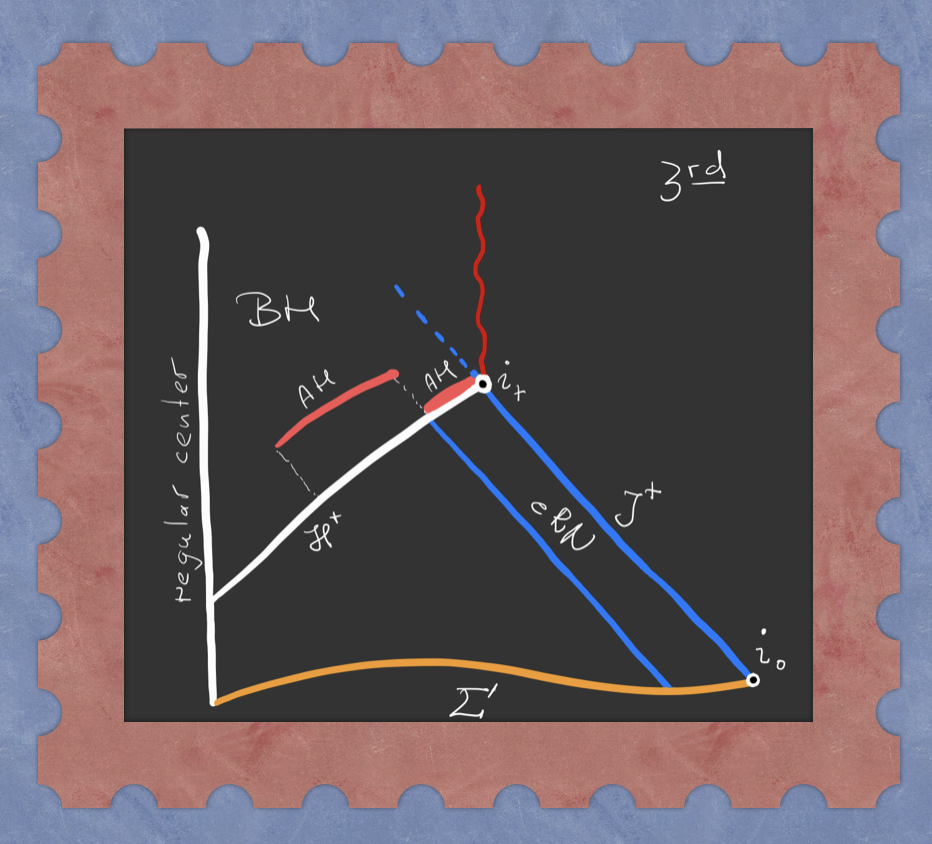
In 1973, Bardeen, Carter, and Hawking conjectured the “third law” of black hole thermodynamics: a subextremal black hole cannot become extremal in finite time—the black hole analogue of Nernst’s unattainability theorem in classical thermodynamics. After reviewing basics of extremal black hole geometry, I will discuss some history of the third law, its various formulations, early counterexamples, Israel’s (flawed) 1986 proof, the intervening dark years, and its eventual disproof (in some settings, see Reall’s talk!) in my joint work with Kehle.
Coffee Break
11th Floor Collaborative Space
Naturalness & Observability of High Energy Collisions around (Near-)Extremal Black Holes
11th Floor Lecture Hall
Speaker
Delilah Gates, Harvard University
Session Chair
Thomas Maedler, Universidad Diego Portales
Abstract
Over a decade and half ago, Banados, Silk, and West (BSW) discovered that particle traveling along geodesics can collider near the horizon of a black hole (BH) with arbitrarily high center-of-mass (CM) energy if one of the particles has its angular momentum tuned to a critical value, opening the prospect that BHS may act as act as high-energy particle colliders (HEPCs).
It has been speculated that rapidly rotating black holes (BHs) with accretion disks---either prograde or retrograde---are natural astrophysical HEPCs because BSW-type collisions can occur between particles falling in from infinity and particles in the disk.
In this talk, I present work to understand the naturalness and observability of these high-energy collisions around (near-)extremal BHs.
I will highlight 1) the landscape of conditions under which these BSW-type collisions occur, 2) the most viable accretion disk configuration conducive to BHs acting as astrophysical HEPCs via BSW-type collisions when considering scattering, and 3) the observability as measure by the escape probability and expected energy of emission born of a BSW-type collision.
Critical Phenomena in the Collapse of Gravitational Waves
11th Floor Lecture Hall
Speaker
Thomas Baumgarte, Bowdoin College
Session Chair
Thomas Maedler, Universidad Diego Portales
Abstract
Critical Phenomena, including the appearance of universal scaling laws and critical exponents in the vicinity of phase transitions, appear in different fields of physics and beyond. Critical phenomena in gravitational collapse to black holes were first observed by Matt Choptuik over 30 years ago - a seminal discovery that launched an entire new field of research. While these phenomena are well understood in spherical symmetry, critical collapse of gravitational waves, i.e. in the absence of spherical symmetry, has remained elusive. In this talk I will review the appearance of universality, scaling laws, and self-similarity close to the onset of black hole formation, and will then present an overview of recent simulations of gravitational-wave collapse. These results do not provide any evidence for the universality of the threshold solution, and instead suggest that our notion of critical collapse in the absence of spherical symmetry will have to be broadened.
The Nonlinear Development of Charged Horizon Instabilities
11th Floor Lecture Hall
Speaker
Zachary Gelles, Princeton University
Session Chair
Floria Wang, University of Cambridge
Abstract
Extremal black holes are known to develop a horizon instability in the presence of scalar matter. In this talk, I will discuss how this picture extends to charged perturbations, which can trigger new instabilities via both gravitational and electromagnetic interactions. In particular, I will demonstrate that on a fixed background metric, charged matter can accumulate on the event horizon of an extremal Reissner-Nordstrom black hole without decaying, thus posing a new challenge to black hole stability. I will then present a numerical evolution of the same problem in the nonlinear setting, where metric backreaction is included. Under certain conditions, the accretion and scattering of charged matter can trigger nonlinear instabilities in a manner that electrically neutral matter cannot. These results shed light on the nature of the extremal horizon and have implications for the more astrophysically relevant Kerr problem.
Coffee Break
11th Floor Collaborative Space
A SIMPLE HYPERBOLOIDAL FOLIATION OF KERR-NEWMAN SPACETIME
11th Floor Lecture Hall
Speaker
Jeffrey Winicour, University of Pittsburgh
Session Chair
Floria Wang, University of Cambridge
Abstract
Hyperboloidal foliations which extend to future null infinity are advantageous in extracting gravitation radiation and monitoring the approach to horizon formation. I will present and discuss the properties ofa simple hyperboloidal foliation of the Kerr-Newman family of charged, spinning black hole spacetimes.
Reception
11th Floor Collaborative Space
Tuesday, January 06, 2026
Critical collapse in 2+1 gravity
11th Floor Lecture Hall
Speaker
Serban Cicortas, Princeton University
Session Chair
David Garfinkle, Oakland University
Abstract
Starting with the work of Choptuik '92, numerical relativity predicts that naked singularity spacetimes arise on the threshold of dispersion and black hole formation, a phenomenon referred to as critical collapse. In this talk, I will present for 2+1 gravity the first rigorous construction of threshold naked singularities in general relativity. Joint work with Igor Rodnianski (Princeton University).
Coffee Break
11th Floor Collaborative Space
The interior of black holes in gravitational collapse
11th Floor Lecture Hall
Speaker
Maxime Van de Moortel, Rutgers University
Session Chair
David Garfinkle, Oakland University
Abstract
The nature of the singularity in the interior of a black hole formed from gravitational collapse remains a profound open problem, even in classical General Relativity! The celebrated Oppenheimer-Snyder solution provides a simple example where the singularity is entirely spacelike: however, this feature is highly non-generic: for instance, it is known that dynamical perturbations of Kerr black holes feature a null Cauchy horizon.
In view of this, it has been conjectured that the generic singularity structure is mixed: containing both a null (weakly singular) piece and a stronger spacelike singularity. I will present a comprehensive analysis of co-existing null and spacelike singularity in spherical symmetry in the context of a charged scalar field. This analysis yields the first construction of a gravitational collapse spacetime exhibiting this feature, providing a new, more generic model for black hole interiors contrasting with Oppenheimer-Snyder’s example.
Can black holes evaporate past extremality?
11th Floor Lecture Hall
Virtual Speaker
Samuel Gralla, University of Arizona
Session Chair
David Garfinkle, Oakland University
Abstract
Black holes with sufficiently large initial charge and mass will Hawking-evaporate towards the extremal limit. The emission slows as the temperature approaches zero, but still reaches the point where a single Hawking quantum would make the object superextremal, removing the horizon. We take this semiclassical prediction at face value and ask: When the emission occurs, what is revealed? Using a model of thin-shell collapse with subsequent accretion/evaporation by a null flux of ingoing positive/negative energy (charged Vaidya spacetime glued to a flat interior), we find two possible outcomes: (i) For shells that are initially very tightly bound, a timelike singularity forms and later appears; or (ii) for unbound or modestly bound shells, the matter re-emerges as a null shell that expands to infinity. This expanding remnant has been bathed in the ingoing Hawking quanta during evaporation and presumably carries correlations with the outgoing quanta, offering the attractive possibility of studying information paradox issues in a setup where spacetime curvatures are globally small, so that quantum gravity is not required. Even for ordinary black holes that evaporate down to the Planck size, we propose a radical new scenario for the interior: rather than forming a singularity, the collapsing matter settles onto an *outgoing* null trajectory *inside* the horizon for the entirety of evaporation.
Mass inflation for spherically symmetric subextremal charged black holes
11th Floor Lecture Hall
Speaker
Onyx Gautam, Princeton University
Session Chair
Shohreh Gholizadeh Siahmazgi, Wake Forest University
Abstract
The Cauchy horizon in the interior of a Reissner–Nordström black hole (extremal or subextremal) is subject to an infinite blueshift instability. In 1989, Poisson and Israel discovered a nonlinear manifestation of this instability in the spherically symmetric and subextremal setting called ""mass inflation,"" by which the Hawking mass becomes identically infinite at the Cauchy horizon. As Gajic–Luk showed, mass inflation does not occur in the extremal setting.
We complete the first proof of mass inflation in the subextremal setting for a wave-type matter model, namely the spherically symmetric Einstein–Maxwell–(uncharged) scalar field system. This result follows from a large-data decay result for the scalar field in the black hole exterior combined with works of Dafermos, Luk–Oh, and Luk–Oh–Shlapentokh-Rothman.
TBD
11th Floor Lecture Hall
Virtual Speaker
Helvi Witek, University of Illinois at Urbana-Champaign
Session Chair
Shohreh Gholizadeh Siahmazgi, Wake Forest University
Coffee Break
11th Floor Collaborative Space
Instability of nonlinear scalar field on nearly extremal RNAdS background
Lightning Talks - 11th Floor Lecture Hall
Speaker
Filip Ficek, University of Vienna
Session Chair
Steven Liebling, Long Island University
Abstract
We investigate how the dynamics of a conformal cubic scalar field on the Reissner-Nordström-anti-de Sitter background depends on the black hole size, charge, and choice of boundary condition. We study the whole range of admissible charges, including the extremal case. In particular, we observe the transition in stability of the field for large black holes at the specific critical value of the charge.
Black Hole Dynamics from Penrose Limits
Lightning Talks - 11th Floor Lecture Hall
Speaker
Jaime Redondo Yuste, University of Copenhagen, Niels Bohr Institute
Session Chair
Steven Liebling, Long Island University
Abstract
The Penrose limit maps the geometry near a null geodesic to a plane wave spacetime, yielding a natural correspondence between black hole lightrings and their associated plane waves. This correspondence is powerful, since gravitational perturbations of the plane wave reproduce the high‑frequency limit of perturbations in the original black hole spacetime. In this talk, I present recent results extending this framework to second order in perturbation theory, and I will briefly comment on ongoing work applying these techniques to study perturbations of Kerr-Newman black holes.
3D Summation-By-Parts Schemes on Hyperboloidal Slices
Lightning Talks - 11th Floor Lecture Hall
Speaker
Shalabh Gautam, Beijing Institute for Mathematical Sciences and Applications (BIMSA)
Session Chair
Steven Liebling, Long Island University
Abstract
This talk addresses the numerical part of attaining a stable evolution of the hyperboloidal initial value problems for long times. I will describe a fully 3-dimensional Summation-By Parts (SBP) scheme for a class of linear wave equations on hyperboloidal slices, on a Minkowski background, all derived in spherical polar coordinates. The major strength of this scheme is that it is provably stable, and allows having grid points at the origin and on the z-axis, despite coordinate singularities, and at infinity, despite a formal singularity arising due to compactification. Reducing it to a Cauchy problem on the standard Cauchy slices, or on finite spacelike slices with an outer boundary, is a straightforward exercise. Its generalizations to general, including dynamical, backgrounds is also proposed, which could also be used to evolve a general matter distribution, like fluids, etc. Promising results are obtained, giving hope for application to the nonlinear systems, like the Einstein Field Equations.
Complex scalar fields near the threshold of rotating black hole formation
Lightning Talks - 11th Floor Lecture Hall
Speaker
Daniela Cors, Cambridge University
Session Chair
Steven Liebling, Long Island University
Abstract
Critical phenomena in gravitational collapse has been verified in many matter models in spherical symmetry. Beyond spherical symmetry, simulations of several matter models in different symmetry classes have shown deviations from universality and discrete self-similarity (DSS). In this talk I will present results where universality and exact DSS are present in axisymmetric simulations with angular momentum. I will provide our current interpretation of these results in the context of extremal critical collapse. Time permitted, I will present ongoing work with a different complex scalar field configuration with which to explore extremal rotating black holes.
On the Regularity of the Inner Cauchy Horizon of Extremal Reissner–Nordström Spacetimes
Lightning Talks - 11th Floor Lecture Hall
Speaker
Benedikt Miethke, Leipzig University
Session Chair
Steven Liebling, Long Island University
Abstract
The vanishing surface gravity of the inner Cauchy horizon of extremal black holes renders the extremal Cauchy horizon more stable than its subextremal counterpart. I will present work in progress on the linear wave equation in the interior of extremal Reissner-Nordström spacetimes, which suggests that the extremal Cauchy horizon may be even more stable than previously expected.
Formation of extremal Reissner-Nordstrom black holes: insights from numerics
Lightning Talks - 11th Floor Lecture Hall
Speaker
Maxime Gadioux, University of Cambridge
Session Chair
Steven Liebling, Long Island University
Abstract
An extremal Reissner-Nordström black hole can form in finite time in the gravitational collapse of a massless charged scalar field. The proof of this is based on the method of characteristic gluing, which involves making an Ansatz for the scalar field at the horizon. We initiate a numerical study of characteristic gluing, and investigate the properties of the gluing solutions. We show how these solutions change when the scalar field is massive and the cosmological constant is non-vanishing. We will briefly comment on possible future directions.
Energy decay for the conformal wave equation in Schwarzschild-AdS under dissipative boundary conditions
Lightning Talks - 11th Floor Lecture Hall
Speaker
Alex Tullini, Universitaet Muenster
Session Chair
Steven Liebling, Long Island University
Abstract
In asymptotically Anti–de Sitter black hole spacetimes, energy decay for solutions of the massive wave equation is obstructed by trapping phenomena, notably at the conformal boundary and, in rotating geometries, at the ergoregion. The severity of this obstruction depends on the choice of boundary conditions at infinity. It is well known that reflective boundary conditions lead only to inverse logarithmic decay.
In this talk, we consider the conformal wave equation on Schwarzschild–Anti–de Sitter spacetime, and we show that, under dissipative boundary conditions, solutions exhibit an inverse polynomial decay rate.
Quasinormal Modes, Power Law Tails, and Quantum Effects in Black Hole Spacetimes
Lightning Talks - 11th Floor Lecture Hall
Speaker
Shohreh Gholizadeh Siahmazgi, Wake Forest University
Session Chair
Steven Liebling, Long Island University
Abstract
It is shown that there are relationships between quasinormal modes, power-law tail terms, and quantum effects in black hole spacetimes. The modes of a quantum field in a simple model of black hole formation, at different points in their evolution, exhibit behaviors that can be associated with quasinormal modes and power law tails. This is also true of the modes for a quantum field in the Unruh state in Schwarzschild spacetime. Implications for the stress-energy of the quantum field are discussed.
Slowly rotating stars in light cone coordinates
Lightning Talks - 11th Floor Lecture Hall
Speaker
Olaf Baake, Universidad Diego Portales
Session Chair
Steven Liebling, Long Island University
Abstract
Following Hartle and Thorne, we discuss slowly rotating stars using an expansion of the field equations in angular velocity while having the TOV equations of a non-rotating star as a background model. We use affine-null coordinates, which yield a particularly convenient multipole decoupling of the Einstein equations, allowing for writing down a master equation. Outside the star, the system admits exact solutions that have to be matched with the numerically determined inner solution.
Wednesday, January 07, 2026
The moduli space of dynamical spherically symmetric black hole spacetimes and the extremal threshold
11th Floor Lecture Hall
Speaker
Christoph Kehle, MIT
Session Chair
Ethan Lu, Stanford University
Abstract
We study the moduli space of spherically symmetric, asymptotically flat solutions of the Einstein–Maxwell equations coupled to a real scalar field. Near the Reissner–Nordström family, I will present a proof showing that the black hole region is foliated by codimension-one stable manifolds of constant charge-to-mass ratio, and that the black hole formation threshold is exactly the set of asymptotically extremal black holes. This is based on upcoming joint work with Y. Angelopoulos (BIMSA) and R. Unger (Berkeley).
Coffee Break
11th Floor Collaborative Space
Superradiance, stability and growth on (near-)extremal black holes
11th Floor Lecture Hall
Speaker
Dejan Gajic, University of Cambridge
Session Chair
Ethan Lu, Stanford University
Abstract
Understanding the dynamics of small perturbations of extremal Kerr black holes requires a quantitative analysis of the interplay between the degeneration of the horizon red-shift effect—a stabilizing mechanism—and superradiance, which acts as a destabilizing mechanism. We present forthcoming results from a mathematically rigorous study of this interplay and its impact on precise late-time asymptotics (“late-time tails”) and instabilities for the charged scalar field equation on (near-)extremal Reissner–Nordström spacetimes. This model arises as the linearization of the Einstein–Maxwell–charged scalar field system. We further highlight key similarities and differences with the corresponding problem for the (uncharged) wave equation on (near-)extremal Kerr spacetimes.
The third law for supersymmetric black holes and numerical approaches to characteristic gluing
11th Floor Lecture Hall
Speaker
Harvey Reall, The University of Cambridge
Session Chair
Ethan Lu, Stanford University
Abstract
I will describe (1) a proof of the third law of black hole mechanics for supersymmetric black holes and (2) results of a numerical study of the characteristic gluing construction of solutions describing gravitational collapse to form extremal black holes.
Group Photo (Immediately After Talk)
11th Floor Lecture Hall
TBD
11th Floor Lecture Hall
Speaker
Mihalis Dafermos, Princeton University
Session Chair
Jaime Redondo Yuste, University of Copenhagen, Niels Bohr Institute
Coffee Break
11th Floor Collaborative Space
Modeling binary black holes with nearly extremal spins using numerical relativity
11th Floor Lecture Hall
Speaker
Geoffrey Lovelace, California State University Fullerton
Session Chair
Jaime Redondo Yuste, University of Copenhagen, Niels Bohr Institute
Abstract
Gravitational waves—ripples of warped spacetime—are an entirely new spectrum for observing the universe. The Laser Interferometer Gravitational-Wave Observatory (LIGO) and the Virgo observatory have ignited the era of gravitational-wave astronomy, observing dozens of collisions of black holes and neutron stars to date. Interpreting these observations without bias requires accurate models of the expected waves, models only possible with numerical relativity—solving Einstein's equations on supercomputers. In this talk, I will highlight progress and challenges in using numerical relativity to model binary black holes and the gravitational waves they emit, particularly the challenge of simulating merging binary black holes with spins that are nearly extremal (that is, near the theoretical maximum). I will also discuss how a new generation of observatories, planned for the next decade, will be so much more sensitive that they will need a new generation of numerical relativity calculations with far higher accuracy than today's state of the art. I will present recent progress toward enabling SpECTRE, an open-source, next-generation numerical-relativity code, to simulate binary black holes with rapid spins.
Thursday, January 08, 2026
Simulations of the Einstein-Maxwell-charged scalar field system in null coordinates
11th Floor Lecture Hall
Virtual Speaker
Carsten Gundlach, University of Southampton
Session Chair
Alex Tullini, Universitaet Muenster
Abstract
After a brief introduction to null coordinates in numerical relativity, I present a code for the spherical Einstein-Maxwell-charged scalar field system. It admits initial data on either a single null cone with regular vertex, or on two intersecting null cones, and allows for evolutions through horizons and for singularity excision. I will present simulations of type-II critical collapse, and work on the critical collapse hypothesis for this system.
Coffee Break
11th Floor Collaborative Space
Black hole solutions in affine null coordinates
11th Floor Lecture Hall
Speaker
Emanuel Gallo, Universidad Nacional de Córdoba
Session Chair
Alex Tullini, Universitaet Muenster
Abstract
We present a review of the null affine formulation of Einstein’s equations, which allows them to be written in a hierarchical structure once suitable new variables are introduced. This framework naturally leads to a regularization of variables through its compactified version. After discussing the characteristic formulation in the spherically symmetric case and the description of extremal black holes within this approach, we will turn to stationary and axisymmetric spacetimes with spin. In the weak-spin limit, we will illustrate the method by characterizing the initial data on the future and past horizons and on the bifurcation sphere for the Kerr–Newman family. This new characterization yields coordinate systems that are regular not only in the exterior region but also in a neighborhood of both horizons.
Intrinsic rigidity of extremal horizons and black hole uniqueness
11th Floor Lecture Hall
Speaker
James Lucietti, The University of Edinburgh
Session Chair
Alex Tullini, Universitaet Muenster
Abstract
I will survey the classification of extremal horizons in vacuum spacetimes (including a cosmological constant) and present a recent rigidity theorem which shows that the intrinsic geometry of compact cross-sections of such horizons must admit a Killing vector field. In particular, this implies that the extremal Kerr horizon is the most general such horizon in four-dimensional General Relativity, completing their classification. I will also discuss the application of such horizon rigidity to the corresponding black hole classification, including a recent uniqueness theorem which shows that the extremal Schwarzschild de Sitter spacetime (or its near-horizon geometry) is the only analytic Einstein spacetime with positive cosmological constant that contains a static extremal horizon with a compact cross-section.
Open Discussion
Other - 11th Floor Lecture Hall
Project Leader
Mihalis Dafermos, Princeton University
Project Leader
Harvey Reall, The University of Cambridge
Project Leader
Huan Yang, Perimeter Institute for Theoretical Physics
Coffee Break
11th Floor Collaborative Space
Scalar and gravitational horizon hair as observable imprints of extremal black hole spacetimes
11th Floor Lecture Hall
Speaker
Som Bishoyi, University of Massachusetts Dartmouth
Session Chair
Daniela Cors, Cambridge University
Abstract
The classical no-hair theorems assert that black holes are characterized by only a few parameters (mass, charge, spin), but recent work challenges this simplification — at least in the extremal limit. Recent theoretical investigations suggest a potential "loop hole" in the traditional no-hair theorem, revealing that certain conserved charges, known as horizon hair, can persist on their event horizons in the context of linearized perturbation theory. Our research focuses on providing strong numerical evidence for the external measurability of these charges. By analyzing the late-time asymptotic tail behavior of the radiation field at future null infinity, we derive and numerically analyse a characteristic expression to confirm that it is non-zero only in the extremal case (ERN and EK) and asymptotes to zero for subextremal cases. This finding establishes it as an observational signature for extremality. We then extend this concept to the more astrophysically relevant scenario of non-axisymmetric gravitational perturbations on extremal Kerr spacetime. We propose a non-axisymmetric gravitational charge based on the transverse derivative of the Beetle-Burko scalar on the horizon. Through numerical solutions of the Teukolsky equation, focusing on the dominant radiative quadrupolar (ℓ=m=2) mode, we show that the quantity is conserved on the horizon at late times. Crucially, we demonstrate a linear relationship between this conserved horizon charge and the associated Ori-coefficient that can be extracted from the black hole's exterior at a finite distance. This connection suggests that the non-axisymmetric gravitational hair is also potentially observable.
Friday, January 09, 2026
Numerical simulations of black hole interiors
11th Floor Lecture Hall
Speaker
David Garfinkle, Oakland University
Session Chair
Lili Fehertoi-Nagy, University of Cambridge
Abstract
This talk will report on preliminary results of numerical simulations that probe the region inside the black hole event horizon. This region is expected to contain both a spacelike singularity and a null singularity. A major challenge is to map out the entire black hole interior region and to be able to tell the difference between the two types of singularity.
Coffee Break
11th Floor Collaborative Space
Obstructions for trapped submanifolds
11th Floor Lecture Hall
Speaker
Gustavo Dotti, Universidad Nacional de Córdoba
Session Chair
Lili Fehertoi-Nagy, University of Cambridge
Abstract
Obstructions and barriers for compact trapped submanifolds in arbitrary dimensional spacetimes are given, with emphasis on trapped loops in four dimensions, which are considered as signatures of black hole interiors.
Ringing Black Holes
11th Floor Lecture Hall
Speaker
Huan Yang, Perimeter Institute for Theoretical Physics
Session Chair
Lili Fehertoi-Nagy, University of Cambridge
Abstract
In this talk I will discuss one of the frontiers of both theory and data analysis in gravitational wave astronomy - understanding the ringing of black holes and probing them from real data. I will review past efforts started from Chandrasekhar, Detweiler, et al in analyzing modes of black holes and explain what we currently understand in both linear and nonlinear wave properties, as well as the corresponding detection aspect. At last I will show a few pressing problems and where we will be heading.
TBD
11th Floor Lecture Hall
Speaker
Deborah Ferguson, University of Rhode Island
Session Chair
Filip Ficek, University of Vienna
Coffee Break
11th Floor Collaborative Space