Loading...
Organizing Committee
Technische Universität Berlin
James Madison University
The Florida State University
Harvard University
University of Florida
Abstract
This workshop brings together researchers from three distinct streams of mathematics: the classical rigidity theory of bar-joint and tensegrity frameworks in combinatorics and discrete geometry; the theory of generalized circle packing that arose from the study of 3-manifolds in geometric topology, extending to sphere packing and jamming; and discrete differential geometry. A scattering of results in recent years has started to forge connections among these fields.
Since the discovery that circle packings from triangulations could be used as a scheme for approximating the Riemann mapping of a simply connected proper domain in the plane to the unit disk, the theory of circle packing has enjoyed enormous development and has found widespread theoretical and practical applications. In the theoretical realm, circle packing provides a discrete analytic function theory that is faithful to its continuous cousin and it is closely associated with studies of hyperbolic and projective polyhedra. The theory has been applied to build discrete minimal surfaces, conformally flatten curved and crumpled surfaces, and push further our understanding of the rigidity and existence of non-compact hyperbolic polyhedra.
Recent work has shown that Euclidean frameworks have an affinity with circle and sphere packings, with Euclidean rigid motions replaced by Mobius transformations, and that the language and methods of rigidity theory could provide a guide for how to approach certain problems in circle packings, sphere packings, and jamming. For example, working in the space of circles in which circles are points, coaxial families of circles are lines, and certain bundles of circles are planes, a 3-dimensional incidence geometry appears that behaves in many ways as the usual Euclidean 3-dimensional space.
The main aim of the workshop is to encourage the cross-fertilization of such ideas, with particular emphasis on the rigidity of inversive distance packings. Participants will attend presentations on cutting-edge research and initiate new collaborations.
Since the discovery that circle packings from triangulations could be used as a scheme for approximating the Riemann mapping of a simply connected proper domain in the plane to the unit disk, the theory of circle packing has enjoyed enormous development and has found widespread theoretical and practical applications. In the theoretical realm, circle packing provides a discrete analytic function theory that is faithful to its continuous cousin and it is closely associated with studies of hyperbolic and projective polyhedra. The theory has been applied to build discrete minimal surfaces, conformally flatten curved and crumpled surfaces, and push further our understanding of the rigidity and existence of non-compact hyperbolic polyhedra.
Recent work has shown that Euclidean frameworks have an affinity with circle and sphere packings, with Euclidean rigid motions replaced by Mobius transformations, and that the language and methods of rigidity theory could provide a guide for how to approach certain problems in circle packings, sphere packings, and jamming. For example, working in the space of circles in which circles are points, coaxial families of circles are lines, and certain bundles of circles are planes, a 3-dimensional incidence geometry appears that behaves in many ways as the usual Euclidean 3-dimensional space.
The main aim of the workshop is to encourage the cross-fertilization of such ideas, with particular emphasis on the rigidity of inversive distance packings. Participants will attend presentations on cutting-edge research and initiate new collaborations.
Loading...
Loading participant list in background...
Workshop Schedule
Monday, February 10, 2025
8:50 - 9:00 AM EST
Welcome
Welcome - 11th Floor Lecture Hall
Brendan Hassett, ICERM/Brown University
9:00 - 9:45 AM EST
Why Does Rigidity Matter?
11th Floor Lecture Hall
Speaker
Robert Connelly, Cornell University
Session Chair
Meera Sitharam, University of Florida
Abstract
Rigidity of frameworks, especially tensegrity frameworks appear in many natural and unexpected places. A tensegrity is just a configuration of points in some Euclidean space, together with upper distance constraints (cables) or lower distance constraints (struts) for some pairs of the vertices. I'll show physical tensegrities with chains for cables and steel tubes for struts, where you can "feel" the rigidity with your hands, and other tensegrities, where the rigidity is lurking in the background. I will also show connections of rigidity to circle and sphere packings, where configurations in a lower dimension are rigid, universally, in any higher dimension, where rigidity is related to polyhedra, and questions where certain kinds natural rigidity are not known, .. yet.
10:00 - 10:30 AM EST
Coffee Break
11th Floor Collaborative Space
10:30 - 11:15 AM EST
Experimental Takes: circle packing and discrete schwarzians
11th Floor Lecture Hall
Speaker
Kenneth Stephenson, University of Tennessee
Session Chair
Meera Sitharam, University of Florida
Abstract
This talk will emphasize the value of experimental approaches to a variety of topics in conformal geometry, particularly using the software "CirclePack". Emerging notions related to discrete Schwarzian derivatives will be illustrated.
11:30 AM - 12:15 PM EST
Smooth Isometries of Quad Nets
11th Floor Lecture Hall
Speaker
Andy Sageman-Furnas, North Carolina State University
Session Chair
Meera Sitharam, University of Florida
Abstract
We introduce a new notion of isometry between immersions of a quad graph in Euclidean 3-space. In contrast to bar-joint frameworks, corresponding edges may not have the same length in 3-space. Instead, one compares using certain lifts to 4-space. This allows to capture the structure of smooth isometries, independent of resolution. Exemplifying this perspective, we discuss computational experiments immersing a 5x7 quadrangulation of a torus, which led to the discovery of analytic compact Bonnet pairs: two noncongruent tori that correspond via a mean-curvature preserving isometry (Bobenko, Hoffmann, S.-F., 2023).
More generally, we develop spin (conformal) transformations, where an invariant spin cross-ratio generalizes the complex cross-ratio. This allows us to define non-planar quad nets in conformal coordinates, such as discrete Bonnet pairs. We also investigate one-parameter isometric associated families of discrete minimal surfaces.
This is joint work with Tim Hoffmann and Max Wardetzky.
12:30 - 2:30 PM EST
Lunch/Free Time
2:30 - 3:15 PM EST
Infinite circle packings on surfaces with conical singularities
11th Floor Lecture Hall
Speaker
Lorenzo Ruffoni, Binghamton University
Session Chair
John Bowers, James Madison University
Abstract
One of the fundamental problems in the theory of circle packings concerns the existence of geometric structures that admit a circle packing with prescribed combinatorics. The case of constant curvature metrics on closed surfaces is well-understood. In this talk we consider non-compact surfaces of finite type and triangulations that are infinite (i.e. punctures are not vertices of the triangulations). We show that given such a triangulation and a collection of target angles satisfying a Gauss-Bonnet inequality, there exists a singular hyperbolic metric admitting a circle packing with the prescribed combinatorics and having the prescribed conical singularities. Moreover, we construct uncountably many examples of hyperbolic metrics that admit a packing with a fixed combinatorics over a fixed punctured Riemann surface, in sharp contrast with a conjecture of Kojima-Mizushima-Tan in the closed case. This is joint work with P. Bowers.
3:30 - 4:00 PM EST
Coffee Break
11th Floor Collaborative Space
4:00 - 4:45 PM EST
Optimal disc and sphere packings
11th Floor Lecture Hall
Virtual Speaker
Daria Pchelina, ENS Lyon
Session Chair
John Bowers, James Madison University
Abstract
How can we arrange an infinite number of spheres to maximize the proportion of space they occupy? Kepler conjectured that the "cannonball" packing is the optimal way to do it. This conjecture remained unproved for almost 400 years until Hales and Ferguson provided a 250-page proof accompanied by hundreds of thousands of lines of computer code.
Given an infinite number of coins of three fixed radii, how can we place them on the plane to maximize the proportion of the covered surface? A disc packing is called triangulated if its contact graph is triangulated. We identified optimal packings for several triplets of disc sizes, all of which are triangulated. Conversely, we also showed that for certain other triplets, no triangulated packing is optimal.
Building on our expertise in multi-size disc packings, we extend our research to two-sphere packings. Simplicial sphere packings are those whose contact graphs form pure simplicial 3-complexes. We consider the only ratio of sphere sizes that allows such packings which are conjectured to be optimal.
5:00 - 6:30 PM EST
Reception
11th Floor Collaborative Space
Tuesday, February 11, 2025
9:00 - 9:45 AM EST
Discrete hyperbolic Laplacian
11th Floor Lecture Hall
Speaker
Wai Yeung Lam, Université du Luxembourg
Session Chair
Steven Gortler, Harvard University
Abstract
The Laplace operator on a Riemannian manifold is a fundamental tool to study the geometry of the manifold. Inspired by electric networks, Laplacians on graphs are defined with edge weights playing the role of conductance. When the edge weights are constant, the graph Laplacian becomes the combinatorial Laplacian and is known to reveal rich combinatorial information of the graph. Given a graph embedded on a surface, it is natural to consider a geometric Laplacian, where edge weights are adapted to the geometry. For the 1-skeleton graph of a geodesic triangulation on a Euclidean surface, there is a “cotangent formula” relating the edge weights to the Euclidean metric. It is known to connect with various problems, e.g. deformations of circle patterns, Delaunay decomposition and discrete harmonic maps. In the talk, we introduce the analogue for hyperbolic surfaces. This is joint work with Ivan Izmestiev.
10:00 - 10:30 AM EST
Coffee Break
11th Floor Collaborative Space
10:30 - 11:15 AM EST
Triangulated Packings of the plane with at least 2 sizes
11th Floor Lecture Hall
Speaker
Zhen Zhang, Tsinghua University
Session Chair
Steven Gortler, Harvard University
Abstract
It is well known that there exists a triangulated packing in the plane with equal sized disks - the hexagonal packing. Assuming the largest disks have unit radii, we can interpret the radii of the smallest disks, q, as a measure of how uniform a packing is. The hexagonal packing is the most uniform triangulated packing. What is the second most uniform triangulated packing? Fejes Toth proposed a packing with q~0.638 in his book Regular Figures published in 1965. Fernique improved it with another packing with q~0.651 in 2019. We will discuss the connection between this problem and rigidity theory.
11:30 AM - 12:15 PM EST
TBA
11th Floor Lecture Hall
Speaker
Louis Theran, University of St Andrews
Session Chair
Steven Gortler, Harvard University
12:30 - 2:00 PM EST
Lunch/Free Time
2:00 - 2:45 PM EST
Expansive tree metrics and origami design
11th Floor Lecture Hall
Speaker
Ileana Streinu, Smith College
Session Chair
John Bowers, James Madison University
Abstract
will discuss properties, variations, adaptations and simplifications of Lang’s algorithm for origami design, along with open questions, some of an experimental nature. The input to Lang’s method is a topologically embedded metric tree, from which one has to produce first a convex polygonal region compatible with the tree metric in an “expansive” fashion. Lang’s universal molecule algorithm produces creases that induce a 3D-folded version of the pattern, which may or may not be reachable from the flat state through a continuous deformation.
I will start with an expository survey of Lang’s algorithm and results obtained about 10 years ago with John Bowers, continue with some recent answers to older questions and conclude with further new problems.
3:00 - 5:00 PM EST
Wednesday, February 12, 2025
9:00 - 9:45 AM EST
Convergence of discrete conformal maps on surfaces and the determinant of the discrete Laplacian on a simplex
11th Floor Lecture Hall
Speaker
David Glickenstein, University of Arizona
Session Chair
Philip Bowers, The Florida State University
Abstract
We will discuss two topics relevant to this workshop: (1) A general framework for convergence of discrete conformal mappings is given that works for a wide variety of discrete conformal structures and on general Riemannian surfaces. This framework is a direct generalization of the framework of the proof of Rodin-Sullivan together with Z. He/He-Rodin’s work on convergence of the derivative of circle packing maps. The proof utilizes Riemannian barycentric coordinates and axiomatizes a generalization of hexagonal rigidity. (2) The finite volume Laplacian that appears in discrete conformal variations of angles is studied on a single simplex in all dimensions. The determinant of this operator in two dimensions has had a geometric interpretation for some time, and we will look at the generalization of this formula to a Euclidean simplex in any dimension with arbitrary choice of orthogonal dual structure. Connections of this work to the linear algebra of spheres/hyperplanes as points in Minkowski space will be emphasized.
10:00 - 10:30 AM EST
Coffee Break / Movie
Coffee Break - 11th Floor Collaborative Space
10:30 - 11:15 AM EST
Approximation results for discrete minimal surfaces and discrete conformal maps in the plane
11th Floor Lecture Hall
Speaker
Ulrike Bücking, Freie Universität Berlin
Session Chair
Alexander Bobenko, Technische Universität Berlin
Abstract
Similarly, as for smooth minimal surfaces, a discrete minimal surface may locally be constructed from a given discrete conformal map. However, there exists meanwhile a variety of definitions for discrete conformality and thus for the construction of discrete conformal maps and corresponding discrete minimal surfaces. In my talk, I will focus on two construction principles for discrete minimal surfaces, namely from boundary values of the smooth conformal map (Dirichlet problem) and from a real-analytic framed curve on the smooth minimal surface (Björling problem). For both cases, I explain the choice of a suitable definition for discrete conformality and the corresponding discrete construction principles. Furthermore, the main ideas of the proofs for the (local) approximation properties of the discrete and smooth conformal maps and minimal surfaces are presented.
The approximation results for the Björling problem are joint work with Daniel Matthes.
11:30 AM - 12:15 PM EST
Lorentz sphere congruences, circle patterns and maximal surfaces
11th Floor Lecture Hall
Speaker
Niklas Affolter, TU Vienna
Session Chair
Alexander Bobenko, Technische Universität Berlin
Abstract
We consider discrete congruences of touching spheres in Lorentz space and show how they correspond to circle patterns. Our correspondence is a sphere geometric interpretation of a Lorentz lift previously introduced by Chelkak. Moreover, we identify a special case of circle patterns that corresponds to S-isothermic surfaces in Lorentz space. Finally, we discuss a case that is even more special: the case of maximal surfaces in Lorentz space. This talk is based on joint work with Dellinger, Müller, Polly and Smeenk.
12:25 - 12:30 PM EST
Group Photo (Immediately After Talk)
11th Floor Lecture Hall
12:30 - 2:30 PM EST
Networking Lunch
Working Lunch - 11th Floor Collaborative Space
2:30 - 3:15 PM EST
Hyperideal Circle Patterns: A Möbius-Theoretic Approach
11th Floor Lecture Hall
Speaker
Carl Lutz, TU Berlin
Session Chair
Philip Bowers, The Florida State University
Abstract
"We study circle patterns that locally correspond to weighted Delaunay triangulations of configurations of disjoint disks. These patterns, when modeled on metric geometries such as the Euclidean or hyperbolic plane, have been successfully applied to the study of discrete conformal maps. They exhibit discrete uniformization theorems and possess strong approximation properties. Moreover, when considered at the ideal boundary of hyperbolic 3-space, these discrete conformal mapping problems relate to the realization of hyperbolic surfaces as boundaries of periodic convex polyhedra.
The concept of a circular disk — and by extension, hyperideal circle patterns — naturally extends to the broader setting of the complex projective plane. In this talk, I will introduce the Möbius-theoretic framework required to describe the configuration spaces of hyperideal circle patterns and discuss their associated realization problems."
3:30 - 4:00 PM EST
Coffee Break
11th Floor Collaborative Space
4:00 - 4:45 PM EST
Discrete uniformization problem for non-compact polyhedral surfaces
11th Floor Lecture Hall
Speaker
Feng Luo, Rutgers University
Session Chair
Philip Bowers, The Florida State University
Abstract
"The classical uniformization theorem for Riemann surfaces is well-established for both compact and non-compact connected surfaces. However, in the discrete setting, the discrete uniformization theorem is only known for compact surfaces. In this talk, we will propose a discrete uniformization problem for all surfaces. We will discuss our recent work on the uniformization problem for all polyhedral surfaces of non-abelian fundamental groups and the discrete Schwarz-Pick-Ahlfors lemma. This is joint work with Yanwen Luo."
Thursday, February 13, 2025
9:00 - 9:45 AM EST
Discrete surfaces of constant mean curvature
11th Floor Lecture Hall
Speaker
Nina Smeenk, TU Berlin, Germany
Session Chair
Alexander Bobenko, Technische Universität Berlin
Abstract
"Smooth surfaces of constant mean curvature (cmc) and minimal surfaces are well-known examples of isothermic surfaces. A discretization of minimal surfaces in terms of discrete S-isothermic surfaces was introduced by Bobenko, Hoffmann, and Springborn in 2006. These surfaces can be constructed from spherical orthogonal circle patterns, which serve as their Gauss maps. The orthogonal circle patterns themselves can be constructed from boundary data by minimizing a corresponding functional. Generalizing from minimal surfaces to cmc surfaces, the Gauss maps generalize to orthogonal ring patterns consisting of pairs of concentric circles such that neighboring rings intersect orthogonally.
We present a method for constructing discrete analogues of given smooth cmc surfaces and see examples in R^3 and in Lorentz-Minkowski space R^{2, 1}.
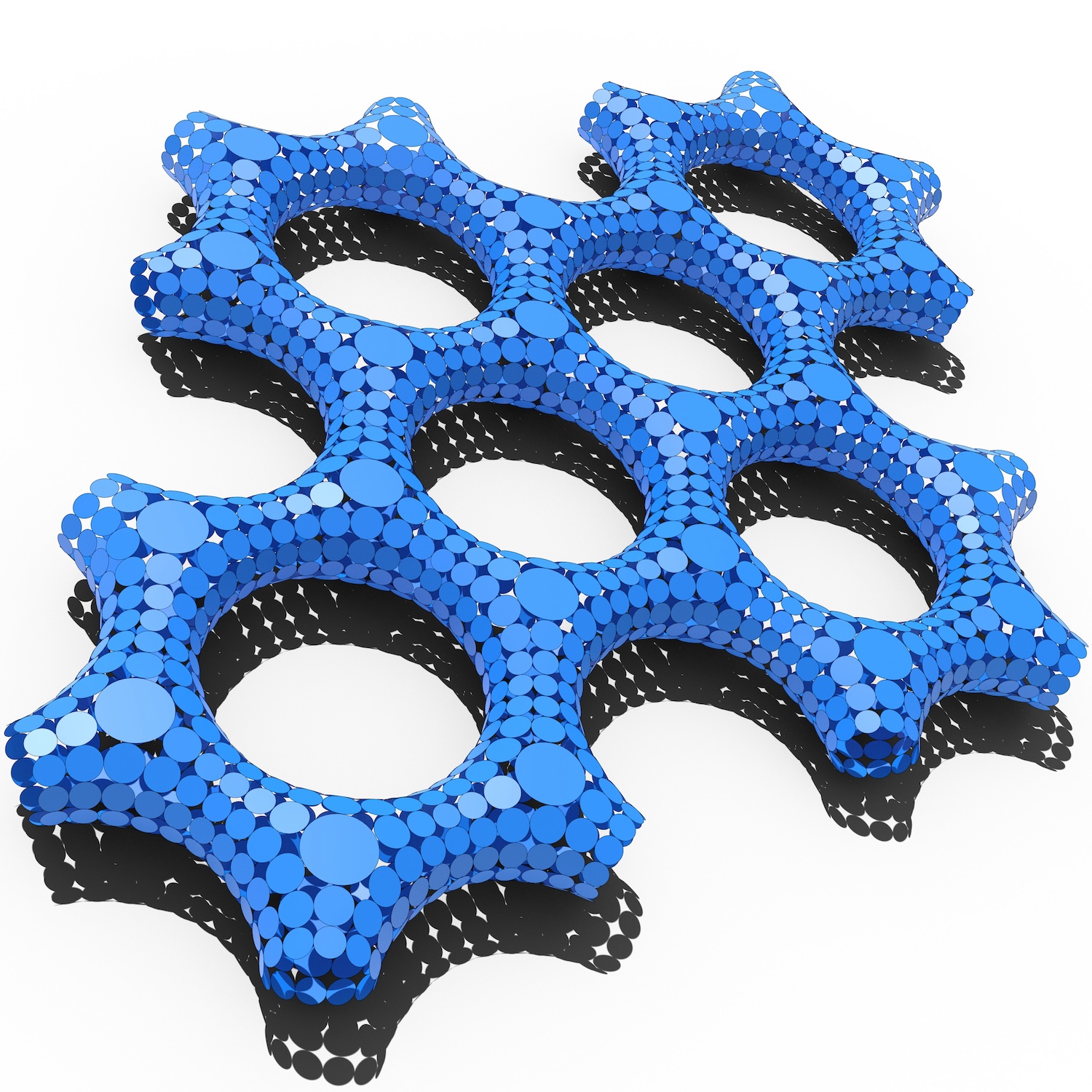
The image on the workshop website shows a doubly periodic S-isothermic cmc surface with hexagonal lattice symmetries in R^3.
This talk is based on joint work with Alexander Bobenko and Tim Hoffmann. "
10:00 - 10:30 AM EST
Coffee Break
11th Floor Collaborative Space
10:30 - 11:15 AM EST
Discrete parametrized surfaces via binets
11th Floor Lecture Hall
Speaker
Jan Techter, Technische Universität Berlin
Session Chair
Alexander Bobenko, Technische Universität Berlin
Abstract
"In several classical examples discrete surfaces naturally arise as pairs consisting of combinatorially dual nets describing the ""same"" surface. These examples include Koebe polyhedra, discrete minimal surfaces, discrete CMC surfaces, discrete confocal quadrics, and pairs of circular and conical nets. Motivated by this observation we introduce a discretization of parametrized surfaces via binets, which are maps from the vertices and faces of the square lattice into space.
We look at discretizations of various types of parametrizations using binets. This includes conjugate binets, orthogonal binets, Gauß-orthogonal binets, principal binets, Kœnigs binets, and isothermic binets. Those discretizations are subject to the transformation group principle, which means that the different types of binets satisfy the corresponding projective, Möbius, Laguerre, or Lie invariance respectively, in analogy to the smooth theory. We discuss how the different types of binets generalize well established notions of classical discretizations.
This is based on joint work with Niklas Affolter and Felix Dellinger."
11:30 AM - 12:15 PM EST
Spherical curvature lines on discrete minimal surfaces
11th Floor Lecture Hall
Speaker
Gudrun Szewieczek, Technical University of Munich
Session Chair
Alexander Bobenko, Technische Universität Berlin
Abstract
"Smooth minimal surfaces foliated by a family of spherical curvature lines were classified by Dobriner and Wente. Renewed interest in these surfaces stems from the finding that they provide special solutions to free boundary and capillary problems.
In this talk, we shall generate discrete minimal surfaces with one family of spherical parameter lines. The construction exploits the fact that minimal surfaces belong to the integrable class of isothermic surfaces and is based on the concept of lifted-folding. The latter is a recently developed method that allows discrete isothermic surfaces with spherical curvature lines to be built from specific holomorphic maps."
12:30 - 2:30 PM EST
Lunch/Free Time
2:30 - 3:15 PM EST
Finite subdivision rules
11th Floor Lecture Hall
Speaker
William Floyd, Virginia Tech
Session Chair
Steven Gortler, Harvard University
Abstract
Finite subdivision rules were defined for a toy problem for the Cannon-Floyd-Parry approach to Cannon's Conjecture. More recently, they've been used extensively in the topological side of complex dynamics. I'll give an overview of finite subdivision rules and how they have come up in discrete conformal geometry.
3:30 - 4:00 PM EST
Coffee Break
11th Floor Collaborative Space
4:00 - 4:45 PM EST
Gordian Links
11th Floor Lecture Hall
Speaker
Joel Hass, University of California, Davis
Session Chair
Steven Gortler, Harvard University
Abstract
Abstract knots and links are 1-dimensional. Knots and links in the real world are made of ropes of some thickness. We will discuss how this affects knot theory, including a connection to circle packing. This is joint work with Jose Ayala Hoffman.
Friday, February 14, 2025
9:00 - 9:45 AM EST
Mechanically balanced packings and configuration space topology
11th Floor Lecture Hall
Speaker
Matthew Kahle, Ohio State University
Session Chair
Meera Sitharam, University of Florida
Abstract
"Configuration spaces of hard spheres (in two dimensions hard disks) are a natural generalization of configuration spaces of points, which are well studied in topology. They also represent the phase space or energy landscape for a hard spheres system, so they are also of interest in physics.
Barsyhnikov, Bubenik, and Kahle showed that the as the radius of the spheres varies, the topology of such a configuration space can only change in the presence of a mechanically balanced configuration. Carlsson, Gorham, Kahle, and Mason did experimental work to find mechanically balanced configurations experimentally, and found that even for a system with only 5 disks in box, the configuration space topology could change dozens of times as the disk radius varies.
I will survey this area, briefly reviewing some of this earlier work and focusing on more recent progress in the area. "
10:00 - 10:30 AM EST
Coffee Break
10:30 - 11:15 AM EST
From Ising, dimers, and UST in 2d statistical physics to discrete surfaces in Minkowski spaces
11th Floor Lecture Hall
Speaker
Dmitry Chelkak, University of Michigan
Session Chair
John Bowers, James Madison University
Abstract
"Planar Ising model, uniform spanning trees, and bipartite dimers are classical examples of free fermionic models in two-dimensional statistical physics. Given a planar graph carrying such a model at or near its critical point – or, a sequence of such graphs with mesh size going to zero – one is interested to find a relevant complex structure that describes the behavior of correlation functions. Recently, it was understood that in many cases this description most naturally comes from discrete two-dimensional surfaces, so-called s- or t-surfaces, embedded into R^{2,1} (Ising model) or R^{2,2}, respectively. I plan to review basic constructions and results obtained on the statistical physics side as well as important open questions about these discrete surfaces."
11:30 AM - 12:15 PM EST
Perfect t-embeddings of Hexagon
11th Floor Lecture Hall
Speaker
Marianna Russkikh, Notre Dame
Session Chair
John Bowers, James Madison University
Abstract
"A new type of graph embedding called a (perfect) t-embedding, was recently introduced and used to prove the convergence of dimer model height fluctuations to a Gaussian Free Field (GFF) in a naturally associated metric, under certain technical assumptions. We will describe a construction of perfect t-embeddings for regular hexagons of the hexagonal lattice and discuss their properties. The construction provides the first example, and hence proves the existence of perfect-t-embeddings for graphs with an outer face of a degree greater than four. As a consequence, this construction leads to a new proof of GFF fluctuations for the dimer model height function on uniformly weighted hexagon."
12:30 - 2:30 PM EST
Lunch/Free Time
2:30 - 3:15 PM EST
Optimal circle and sphere packings in low dimensions using distance distribution.
11th Floor Lecture Hall
Speaker
Oleg Musin, University of Texas Rio Grande Valley
Session Chair
Philip Bowers, The Florida State University
Abstract
In this talk we will discuss Tammes', kissing number and several other sphere packings problems in dimensions three and four. I will consider various approaches to solving these problems and in particular solution methods related to distance graphs. I present an extension of known semidefinite and linear programming upper bounds for spherical codes. The main result can be applied for the distance distribution of a spherical code, and it will be shown that this method can work effectively. In particular, I get a shorter solution to the kissing number problem in dimension 4.
3:30 - 4:00 PM EST
Coffee Break
11th Floor Collaborative Space
4:00 - 4:45 PM EST
Critical gauges for random tilings
11th Floor Lecture Hall
Speaker
Richard Kenyon, Yale University
Session Chair
Philip Bowers, The Florida State University
Abstract
"We discuss probabilistic settings where determining the large-scale behavior of the system amounts to finding a critical gauge. These include a family of random tiling models called ``multinomial random tilings"