Loading...
Organizing Committee
New Jersey Institute of Technology
University of Illinois at Urbana-Champaign
The Hong Kong University of Science and Technology
Hong Kong University of Science and Technology
Abstract
This program will focus on integral equation methods, fast algorithms and their applications to fluid dynamics and materials science. Integral equation methods have been used for more than a century to establish existence and uniqueness results for a variety of elliptic, parabolic and hyperbolic partial differential equations (PDEs). From a computational perspective, they have been used most extensively in the elliptic (steady state or time harmonic) case, because of their ability to handle complex geometry, unbounded domains and radiation conditions and because of the availability of fast algorithms to reduce the cost of handling the dense matrices that arise from their discretization. These algorithms include fast multipole methods (FMM), methods based on the Fast Fourier Transform (FFT) or the non-uniform FFT (“NUFFT”), and hierarchical compression-based methods (wavelet and SVD-based schemes, H-matrices, HSS-matrices, etc.). The fundamental issue is that discretization of an elliptic boundary integral equation yields a dense N × N matrix, where N denotes the number of degrees of freedom used to describe the unknown. The straightforward application of a dense matrix to a vector requires O(N2) work, while classical Gaussian elimination techniques require O(N3) work to solve the system. The various fast algorithms listed above provide the ability to apply the discretized integral operator to a vector in O(N) or O(N log N) operations. When combined with modern iterative methods (such as GMRES), well-conditioned integral equation formulations such as second kind integral equations (SKIEs) have reduced the total work required to near optimal complexity, bringing large scale simulations within practical reach.
The program will bring a group of researchers from the US and HKUST with common interests and complementary expertise to work intensively on constructing well-conditioned integral equation formulations, developing high-order, fast, and robust algorithms with scalable implementation, and applying them to solve complex, large-scale real physical applications in multiphase flows and dislocation dynamics and to propose positive conditions on the Hadamard conjecture.
The program will bring a group of researchers from the US and HKUST with common interests and complementary expertise to work intensively on constructing well-conditioned integral equation formulations, developing high-order, fast, and robust algorithms with scalable implementation, and applying them to solve complex, large-scale real physical applications in multiphase flows and dislocation dynamics and to propose positive conditions on the Hadamard conjecture.
Completed Projects
Organizer Talks
- Shidong Jiang - Introduction on integral equation methods, fast algorithms, and the Hadamard conjecture
- Andreas Kloeckner - Introduction to singular quadrature, simulation of photonic metamaterials, and software frameworks for integral equation computations
- Xiao-Ping Wang - Introduction to interface problem and numerical methods
- Yang Xiang - Introduction to dislocation climb and numerical methods
Student Talks
- Quadrature by Multipole Expansion (Matt Wala)
- Integral Equation Methods for Vortex Dominated Flows, a High-order Conservative Eulerian Approach (Josh Bevan)
- Coupled Elliptic Solvers for Embedded Mesh and Interface Problems (Natalie Beams)
- Parallel algorithms for interface problems (Luo Li)
- Step bunching in epitaxial growth with elasticity effects and convergence from atomistic models to the Peierls-Nabarro model of dislocations (Tao Luo)
- Energy of low angle grain boundaries based on continuum dislocation structure (Luchan Zhang)
- Solving continuum dislocation and plasticity model using finite ele.ment method (Xiaoxue Qin)
- Dislocation climb models from atomistic scheme to dislocation dynamics (Xiaohua Niu)
- Normal mode analysis for nanoscale hydrodynamic model determination (Xiaoyu Wei)
Workshop Topics
- Topic 1: Efficient Methods for the Threshold Dynamics Method and Interface Dynamics
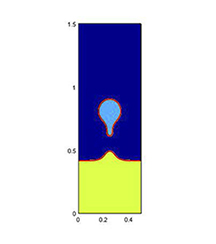
Interfacial phenomena play a vital role in technological applications in such diverse areas as fluids, biology, and material science. Numerical simulation of interface dynamics is a difficult task. The MBO scheme is an efficient numerical method for simulating interface dynamics driven by surface energy minimization. The scheme is also generalized to wetting dynamics and droplet spreading on rough solid surfaces (X. Xu, D. Wang and X.P. Wang, 2015).
In this program, we will develop integral equation formulations and design NUFFT-based fast algorithms for these problems. Compared with existing numerical schemes, the proposed method restricts computation to a small neighborhood of the material interfaces, provides high-order discretization for smooth or piecewise smooth cases, and achieves near-optimal complexity. We will also focus on scalable implementation on modern heterogeneous parallel computers, enabling real 3D problems to be simulated within minutes or hours instead of days or weeks.
Possible Projects:- Develop integral equation formulations and NUFFT-based fast algorithms for problems with complex and rough boundaries.
- Generalize MBO-type schemes to multiphase fluid flow (i.e. coupled with the Navier-Stokes equations).
- Develop parallel algorithms for 3D interface dynamics.
- Topic 2: Fast Numerical Methods for Simulations of Dislocation Climb
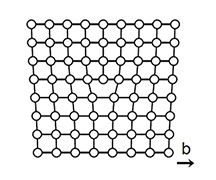
Dislocations are line defects in crystals. The climb motion of dislocations is assisted by diffusion and the emission and/or absorption of vacancies or interstitials, playing a crucial role in plastic deformation of crystalline materials at high temperature.
Recently, Prof. Yang Xiang and collaborators derived a Green’s function formulation for the climb of curved, multiple dislocations in 3D (Y.J. Gu, Y. Xiang, S.S. Quek, and D.J. Srolovitz, *J. Mech. Phys. Solids*, 83, 319–337, 2015). This new formulation captures the long-range contribution to dislocation climb velocity due to vacancy diffusion — a key effect missing in earlier DDD models.
Possible Projects:- Construct second-kind integral equation formulations for equilibrium-state vacancy diffusion.
- Develop and implement FMM/NUFFT-based algorithms to solve the integral equations for dislocation climb.
- Apply the methods to large-scale dislocation climb problems.